Showing posts with label urban agriculture. Show all posts

Saturday, May 19, 2012

A former Chicago meatpacking plant becomes a self-sustaining vertical farm

A vertical farm in a form Chicago meatpacking plant. Rachel Swenie / The Plant

23 April 2012
By Julie Ma

Had Willy Wonka had been fascinated by industrial ecology instead of cocoa beans, his factory may have looked something like The Plant, Chicago’s first entirely self-sustaining "vertical farm."

The Plant occupies a former meatpacking plant and slaughterhouse in the Union Stock Yards, transforming a huge brick building that once specialized in bringing red meat to the masses into a green space all about urban farming without waste. The interior looks like something straight out of a scientific-environmental fantasy.

Tenants include aquaponic farms (think vegetables on water beds flourishing under colored UV lights), a tilapia fish farm, beer and Kombucha tea breweries, a mushroom garden, and a host of independent bakers and caterers that will work together in a communal kitchen space. Future plans include living walls and rooftop gardens.

But the most ambitious part of the building is its focus on producing "net-zero waste" in its 93,500-square-foot space. Spent grains from the beer brewery will feed the tilapia. The waste produced by the fish will feed the mushroom garden or be converted nitrates to feed the hydroponic plants. Those plants will clean the water through natural processes and be cycled back into the fish tanks. Taken together, the system will make the building completely self-sustainable. With the help of a few machines, including an anaerobic digester (similar to a waste-eating mechanical "stomach" that produces biogas) and a combined heat and power system, the building hopes to go off the grid within the next four years.

“Industrial ecology—the concept of using other people’s waste as input—is fascinating. In nature, there’s no waste, but there is so much waste in human consumption and development,” says Melanie Hoekstra, The Plant's director of operations. “This is an obvious problem that we can resolve with a building that can do so many things. It’s not a perfect system, but it’s really close.” […]

A Former Chicago Meatpacking Plant Becomes a Self-Sustaining Vertical Farm

Tuesday, January 19, 2010

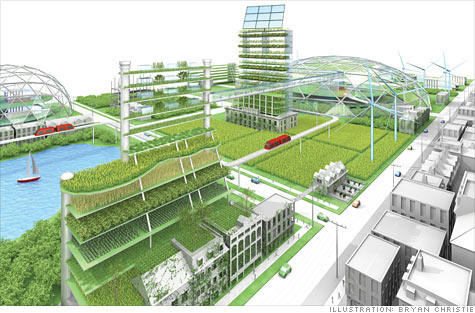
Can farming save Detroit?

urban_agriculture.top.jpg

By David Whitford, editor at large, December 29, 2009: 11:37 AM ET

DETROIT (Fortune) -- John Hantz is a wealthy money manager who lives in an older enclave of Detroit where all the houses are grand and not all of them are falling apart. Once a star stockbroker at American Express, he left 13 years ago to found his own firm. Today Hantz Financial Services has 20 offices in Michigan, Ohio, and Georgia, more than 500 employees, and $1.3 billion in assets under management. …

Then one day about a year and a half ago, Hantz had a revelation. "We need scarcity," he thought to himself as he drove past block after unoccupied block. "We can't create opportunities, but we can create scarcity." And that, he says one afternoon in his living room between puffs on an expensive cigar, "is how I got onto this idea of the farm."

Yes, a farm. A large-scale, for-profit agricultural enterprise, wholly contained within the city limits of Detroit. Hantz thinks farming could do his city a lot of good: restore big chunks of tax-delinquent, resource-draining urban blight to pastoral productivity; provide decent jobs with benefits; supply local markets and restaurants with fresh produce; attract tourists from all over the world; and -- most important of all -- stimulate development around the edges as the local land market tilts from stultifying abundance to something more like scarcity and investors move in. Hantz is willing to commit $30 million to the project. He'll start with a pilot program this spring involving up to 50 acres on Detroit's east side. "Out of the gates," he says, "it'll be the largest urban farm in the world." …

Can farming save Detroit?

Wednesday, August 19, 2009

Empty car parks in London to sprout vegetable plots

By Miranda Bryant

A London council is converting its disused spaces into areas for local people to grow produce in an attempt to make its food supply sustainable by 2050.

Hundreds of unused and abandoned spaces in Enfield are to be converted into fruit and vegetable plots in the hope of the area becoming "London's breadbasket".

Informal growing spaces around the borough, such as car parks, disused garages and empty spaces around blocks of flats, are to be converted into vegetable plots, while two of its rundown parks will become community orchards. The scheme is part of a borough-wide strategy announced today with the aim of reinvigorating food networks and improving sustainability.

"The potential Enfield has for helping to feed itself and London is huge," said council leader Mike Rye. "We have a great agricultural and market garden heritage to build on - in years to come Enfield could become known as the capital's breadbasket."

As part of the £50,000 council-funded scheme, up to 120 trees - including apple, pear, plum and hazelnut - will be planted across two sites.

Community groups will decide what they want to plant and whether they want to sell the produce or eat it themselves. …

Empty car parks to sprout vegetable plots

Technorati Tags:

Tuesday, August 4, 2009

Self-sufficient Detroit? Urban food revolution in Motor City

detroit urban agriculture image

Image credit: Guernica/Jonathan LaRocca

When Adam Stein criticized vertical farms and urban agriculture as "pie in the sky", his principle argument was that downtown urban real estate was too valuable for growing food, and that it would be better served by high-density, efficient housing and businesses, served by a local network of farms in the suburbs. He might have a point in thriving cities like NYC, or Chicago, where it seems hard to envision truly downtown agriculture taking off any time soon - but urban agriculture in Detroit is a whole different kettle of fish. With houses in Detroit going for under $2000, it seems the city might be fertile ground for folks seeking a different model of urban development. In fact, Mark Dowie over at Guernica claims that Detroit could feed itself - and it would be the first US city to do so. To prove his point, he set out to meet people who are trying to make it happen. …

Self-Sufficient Detroit? Urban Food Revolution in Motor City

Technorati Tags:

Thursday, July 30, 2009

Homeless teens to create 'skyscraper garden' above New York City

homeless-teens-green-roof.jpg Whenever it seems like there's a surplus of doom and gloom running through the headlines, you hear about a story like this: at-risk teenagers staying in Covenant House, a homeless shelter in New York City, have set about cultivating green roofs on skyscrapers around the city. Their goal is to create a citywide "skyscraper garden" across Manhattan. The teens recently completed the first stage of the project, done in collaboration with Seeding the City--planting a green roof on the ninth story of a building in midtown Manhattan.

There, they'll be watering, maintaining, and caring for the seedlings, which will eventually be planted on other roofs around the city. By the time they've finished, they'll have created a veritable citywide skyscraper garden. …

Homeless Teens to Create 'Skyscraper Garden' Above New York City

Technorati Tags:

Monday, April 13, 2009

Social network for growing your own food

These folks are getting ready for the Great Recession:

Ooooby

Ooooby is...

- food growers and locavores with a goal of food interdependence.
- a place to learn from, connect and exchange with local growers and eaters.
- a social enterprise which pours profits into food growing projects. …

Out of Our Own Back Yards

Technorati Tags:

Tuesday, April 7, 2009

Financiers to plant farm... in downtown Detroit

Danny Bradbury, BusinessGreen, Tuesday 7 April 2009 at 09:22:00

Investors announce plans for giant urban agribusiness on 10,000 acres of rundown urban sprawl

A Michigan-based financial group has announced ambitious plans to turn large swathes of crime-ridden Detroit into urban farmland. In the long term, Hantz Group hopes to develop up to 10,000 acres of underutilised and vacant land in Downtown Detroit - almost a tenth of the city's 143-square-mile area - and turn it into a mixture of cash crop land, ornamental gardens, and riding trails.

The ambitious scheme will begin with a 70-acre purchase on the city's Lower East Side. Matt Allen, senior vice present for Hantz subsidiary Hantz Farms, who lives close to the proposed "phase one farm", said that the land has been targeted for its low density, and currently supports between zero and nine residents per acre. …

Financiers to plant farm... in downtown Detroit

Technorati Tags: