Tuesday, July 7, 2009

Invisibility cloak modified to make you see things that aren't there

The ever-evolving tale of the invisibility cloak makes us want to hang our heads in our hands sometimes, so fraught with frustrations does it seem. Well, another chapter's been added to the tome: researchers at the Hong Kong University of Science and Technology have devised a way to extend the invisibility principle, allowing an illusion to sit in place of the invisible object. So, say you wanted to use an invisibility cloak to mask the presence of your bottle of beer on the table, the new concept -- or 'shroud of lies' as we call it -- would enable you to make it appear that there was a glass of water sitting there, in place of the beer. So how does that work, exactly? Normal, every day invisibility cloaks bend light around a central cavity, whereas the team has now worked out mathematical rules for bending light in other ways, allowing a material to be designed to bend light in the exact way a spoon would, so that the light hitting the material would distort, making it look like a spoon was there. Theoretically, all of this is rather simple and quite sound, though it turns out that there are numberless mechanical obstacles standing in the way of producing such devices. …

Invisibility cloak modified to make you see things that aren't there

Technorati Tags:

Pickens walks away from world's largest wind farm

pickens-wind-no 

After months of delays due to financing difficulties, T. Boone Pickens is walking away from a plan to build the world's largest wind farm in the Texas Panhandle.  While money played a large part in the decision, the nail in the coffin came from an announcement that $5 million worth of new transmission lines for wind energy in Texas were not going to be built anywhere near the planned site of the wind farm.

Pickens originally planned to build his own transmission lines as well, but tough economic times have scaled back his ambition. …

Pickens Walks Away from World's Largest Wind Farm

Technorati Tags:

Making solar panels sustainably: Niagara Falls to power new Solarworks plant

Niagara Falls. Image credit: State University of New York What is the ultimate green solar panel?

A true-green solar panel must have the following characteristics: design life of major components of equal length (functionality lasts as long as the shortest-lived component); renewable energy used to produce the energy-intensive materials as much as possible (silicon slices, backsheets, aluminum frames, etc.); green chemistry used to produce components and adhesives; and, finished panels easy enough to disassemble that recycling is cost-effective. With that as background, I have good news on one of the four listed precepts. The New York State Power Authority has "awarded a large block of low-cost hydropower to a fledgling California company that plans to build a plant in Western New York to manufacture solar panels." …

Making Solar Panels Sustainably: Niagara Falls To Power New Solarworks Plant

Brazil to build solar-powered charging stations for electric vehicles

brazil motorcycle photo Photo: Flickr, CC

"Electric Vehicles" Mostly Means Electric Bikes, So Far... Petrobras, the semi-public Brazilian oil giant (the government of Brazil owns 55.7% of Petrobras' common shares with voting rights), has just built the first of what it hopes will be many electric charging stations. It is located in the Barra de Tijuca neighbourhood of Rio de Janeiro because that area has the most electric motorcycles and bikes in circulation in the country....

Brazil to Build Solar-Powered Charging Stations for Electric Vehicles

A dollar a day could keep climate change away: EPA

 Lisa Jackson, then President-elect Barack Obama's nominee to be administrator of the Environmental Protection Agency, addresses a question during her confirmation hearing before the Senate Environment and Public Works Committee on Capitol Hill in Washington, January 14, 2009. REUTERS / Jonathan Ernst

By Jasmin Melvin

WASHINGTON (Reuters) - The average American family would pay at most $1 a day more to fight climate change, the head of the U.S. Environmental Protection Agency told a Senate committee on Tuesday.

EPA head Lisa Jackson said carbon-cutting legislation would, on average, amount to a 50-cent per day cost per household in 2020 and edge up for wealthier families, people who drive long distances and those living in states dependent on coal for electricity.

But even a doubling of the national average would only cost families $1 per day, Jackson said.

"Can anyone honestly say that the head of an American household would not spend a dollar a day to safeguard the well being of his or her children?" Jackson asked the Senate Committee on Environment and Public Works.

But the committee's top Republican Senator, James Inhofe, pointed to a July 1 poll by Rasmussen indicating that "56 percent of Americans are not willing to pay anything to fight global warming."

The Democratic-controlled House narrowly passed a climate change bill last month that aims to slash greenhouse gases. Now the Senate is considering its own legislation, a top priority for the Obama administration.

Energy Secretary Steven Chu told the hearing that meeting the greenhouse gas targets in the House bill would cost households in 2020 about the same as buying a postage stamp each day. A first class stamp costs 44 cents.

"History suggests that the actual costs could be even lower," Chu said, noting that sulfur dioxide emission cuts will cost a quarter of the original estimates. …

A dollar a day could keep climate change away: EPA

Technorati Tags: ,

Must-read NOAA paper smacks down the deniers: Q: “Is there any question that surface temperatures in the United States have been rising rapidly during the last 50 years?” A: “None at all.”


Nothing occupies global warming deniers more than trying to prove the U.S. temperature record — a tiny portion of the global temperature record — is not reliable.  Now NOAA’s National Climatic Data Center has issued an excellent Q&A, “Is the U.S. Temperature Record Reliable?” that should settle that question for any objective observer.

The NCDC paper proves we should all be delighted that deniers like Anthony Watts and Steve McIntyre spend so much time on this:  It is clearly a fruitless effort that consumes time which they might otherwise spend spinning out more potent disinformation.

Consider this definitive NCDC graph comparing the U.S. temperature record since 1950 “using 1221 stations in NOAA’s Historical Climatology Network (USHCN)” [red line] with “the 70 stations that surfacestations.org classified as good or best” [purple line].

No discernible difference!

Imagine all the effort by Watts and his cohorts at surfacestations.org and WattsUpWithThat have expended examining some 70% of the 1221 stations around the country — and all they ended up proving is that the best stations give the exact same output as all the rest of the stations! …

Must-read NOAA paper smacks down the deniers: Q: “Is there any question that surface temperatures in the United States have been rising rapidly during the last 50 years?” A: “None at all.”

Technorati Tags:

Monday, July 6, 2009

High altitude wind power: an era of abundance?


By Ugo Bardi

The kitegen concept: high altitude wind power based on kites. In this configuration ("stem"), the kite reaches altitudes of the order of 1000 m; pulling on a power generator located on the ground. High altitude wind power promises to be a low cost and widely available technology able, in principle, to provide amounts of energy comparable, and even superior, to the present production based on fossil fuels. (See here an animated representation of how a stem works)

…The basic idea of high altitude wind power is that wind is more intense as you move up in the atmosphere. The average wind speed increases with height according to an exponent (called "Hellman exponent") which is about 1/7. But the energy contained in a mass of air in movement increases with the cube of speed. From a simple calculation, we see that if we could raise a wind turbine to a height of 800 m, we could increase the power obtained of a factor of 8 in comparison to the same turbine near the ground. Even larger increases are possible at higher altitudes, where winds are also much more constant; easing the intermittency problem of conventional wind turbines. But of course, it is impossible to reach such heights with the current wind technology, limited to about 100 m because of the cost and weight of the tower.

This concept has been clear for a long time and has led to several proposals to tap the wind at higher heights. There are two possible ways for doing that: balloons and wings. You can find a recent summary of the progress in this area in the work by Big Gav (2009) published on TOD . As you can see, there are many ideas in this field, many of which exist only as sketches on paper. In many cases, the energy yield of the proposed systems is only a guess while, for those systems based on aerostats, the need of a non renewable resource (helium) is a considerable limit.

However, a few systems have been studied in depth and some tested in practical experiments. Systems based on rotors are possible and systems based on kites, in particular, do show a lot of promise. Saul Griffith of Makani Power has shown some images of a test done with a three rope kite. Wubbo Ockels, (Delft University of technology) has been also experimenting with a kite , this one using a single rope. In this field, the most advanced system seems to be the "kitegen"; a kite system created by Massimo Ippolito of Sequoia Automation , a company based in Italy. Tests on a prototype system have been completed and a first energy producing plant is being built in Northern Italy.

The Kitegen is a simple aerodynamic system: it uses state of the art kites which create lift dynamically by flying at 70-80 m/sec; this is the speed reached by the tips of the blades of a conventional wind turbine. In the simplest configuration (called "stem"), the system uses a single kite linked to a power generator located on the ground. The kite moves like a yo-yo: when it goes up, it generates energy that is transformed into electric power by the generator. When it reaches its maximum height, it is placed in an aerodynamically non-lifting configuration, so that it can be pulled down at a very small energy cost. Two coupled stems would work like a two-cylinder engine, although the "power" phase would last 90% of the time while the "pull back" phase would be much faster. A single stem could have a maximum power of a few MW. Larger plants could be operated in the "carousel" configuration. In this case, the kites fly at a constant height and at much higher altitudes, pulling a generator that moves on a circular rail. For a large carousel system, the maximum power obtained can be calculated as of the order of 1 GW or even higher. …

High altitude wind power: an era of abundance?

Technorati Tags:

Project will nearly eliminate deadly ghost nets in Puget Sound

Lost fishing nets trap and drown thousands of marine animals annually.by Lisa Stiffler

Lost fishing nets strewn along the bottom of Puget Sound have been drowning thousands of fish, birds, seals, crabs and other marine life each year. And some of these ghost nets have been silently killing creatures for a decade or more.

But now a local conservation group will have the support it needs to clean up most of the mess, thanks to a $4.6 million federal grant. 

The money, which comes from the federal stimulus package, will fund the Northwest Straits Commission’s effort to remove 3,000 lost fishing nets littering Puget Sound.

“Derelict fishing gear is a worldwide issue,” said Ginny Broadhurst, director of the commission. “We seem to have a particularly bad problem here.”

Over the past seven years, the group has removed 1,200 nets from the Sound and around the San Juan Islands by piecing together funding from smaller grants. With the large infusion that’s coming through NOAA Fisheries Service, Broadhurst estimates that 90 percent of the nets in local marine waters will be removed.

During the heyday of gillnetting, about 3,500 fishing permits were issued; that number is down to about 350 today, Broadhurst said. Her group estimates that with the reduction in fishing and improvements in technology, about 10 to 12 nets are lost each year.

“If we can just get this legacy stuff out of here we will have solved the problem,” she said. …

Project will nearly eliminate deadly ghost nets in Puget Sound

Sunday, July 5, 2009

Funding boost for Redmond-based waste methane processor

Plant

Landfills, coal beds and cattle feedlots all produce methane, which is often either flared — that is, burned off — or released into the atmosphere as a greenhouse gas.

Prometheus Energy, a five-year-old company based in Redmond, Wash., has developed a technology to turn that waste methane into liquid natural gas. And the company this week raised $20 million from the Shell Technology Ventures Fund, a fund related to the petroleum company Royal Dutch Shell and Black River Asset Management, a subsidiary of the agriculture giant Cargill.

The deal represents a vote of confidence from a fund connected to the world’s largest nongovernmental producer of liquid natural gas, and industry insiders say it’s a victory for a technology that has remained small until now.

Michael Butler, the chief executive of Cascadia Capital, an investment banking firm that arranged the financing for Prometheus, said that Shell, which has plenty of stranded oil and gas mines that could supply waste methane, wants to help Prometheus expand around the world. The news also signifies a second chance for Prometheus, which was delisted from London’s Alternative Investment Market last year.

The 27-employee company began producing liquid natural gas at plants in Southern California and in southern Utah last year, and expects to start production at a plant in Poland next year, said Kirt Montague, the chief executive of Prometheus. The company takes waste gas that landfills and coal mines already collect for flaring, and purifies it into methane, removing the carbon dioxide, nitrogen, water, oxygen, sulfur and other components, before converting it into liquid natural gas. …

Funding Boost for Waste Methane Processor

Technorati Tags: ,

Papua New Guinea suspends carbon chief amid reports of dodgy deals

Yvonne Chan in Hong Kong, BusinessGreen, Thursday 2 July 2009 at 09:45:00

Foreign firms allegedly paid millions of dollars for unauthorised carbon credits

Theo Yasause, Papua New Guinea's Office of Climate Change (OCC) director, was suspended earlier this week following reports that he issued unofficial carbon credits worth millions of dollars from 39 different forestry projects.

The OCC has been accused of hiring two international brokers to sell carbon credits without the consent of landowners. Moreover, Papua New Guinea does not currently have a legislative framework to issue carbon credits and ensure they are properly verified.

The Economist magazine has obtained documents that suggest a series of multimillion-dollar carbon trading deals were made with foreign companies under the proposed Reduced Emissions from Deforestation and Degradation (REDD) mechanism.

Additionally, the Australian Associated Press news agency claims it has obtained documents showing that Adelaide-based carbon credit broker Carbon Planet paid A$1.2m (£588m, $968m) for projects in Papua New Guinea.

A government investigation was launched last month over the allegations. At the time, Yasause said that stolen "sample" documents, which appear to bear his signature, were leaked to the media.

He has denied any suggestion of wrongdoing, telling Australia's Canberra Times newspaper: "I have not sold or made any money out of this process. I have done no deals, nor sold any credits." …

Papua New Guinea suspends carbon chief amid reports of dodgy deals

ExxonMobil funds climate change sceptics

mining oil - five ways to profit from rising oil prices

Company records for 2008 show that ExxonMobil gave $75,000 (£45,500) to the National Center for Policy Analysis (NCPA) in Dallas, Texas and $50,000 (£30,551) to the Heritage Foundation in Washington.

It also gave $245,000 (£149,702) to the American Enterprise Institute for Public Policy Research in Washington.

The list of donations in the company’s 2008 Worldwide Contributions and Community investments is likely to trigger further anger from environmental activists, who have accused ExxonMobil of giving tens of millions to climate change sceptics in the past decade.

All three groups have raised questions about global warming.

The Heritage Foundation published note last year that said: “Growing scientific evidence casts doubt on whether global warming constitutes a threat, including the fact that 2008 is about to go into the books as a cooler year than 2007”.

ExxonMobil promised in 2006 to stop funding climate change sceptics after it was criticised by the Royal Society for giving money to researchers who were “misinforming the public about the science of climate change”.

In its 2008 corporate citizenship report, published last year, ExxonMobil repeated that it would cut funds to several groups that “divert attention” from the need to find new sources of clean energy.

The company has cut funding to several of the more controversial groups, including Frontiers for Freedom, who said in 2007: “The truth is, there is no conclusive or reliable scientific proof that the sky is falling or that Earth’s climate is experiencing cataclysmic warming caused by man’s activities.” The George C Marshall Institute also did not receive any Exxon money last year. …

ExxonMobil funds climate change sceptics

Technorati Tags:

Energy-pioneering Austrian town exports its model

After 20 years investing in renewable energy, the small Austrian town of Guessing, a model of energy self-sufficiency, is spreading its pioneering technology far and wide.

A town of 4,300 inhabitants near the Hungarian border, Guessing launched into renewable energy in the early 1990s and now produces more than it can consume.

The latest project, opened last week, is a one-megawatt plant capable of producing gas from wood chips.

According to its backers, this gas can be used in normal gas networks, urban heating systems, and cars or power stations that work on gas.

The technology, developed jointly with Switzerland, has already attracted attention from major energy companies.

"Vattenfall (from Sweden), EDF (France) and E.ON (Germany) are all interested in the plant," Guessing's mayor Peter Vadasz noted proudly.

A similar plant to the one in Guessing -- which can heat 150 homes on a cold winter's day -- but 25 times more powerful is already in the works in Goeteborg, Sweden.

About 20 years ago, Guessing was still a sleepy town in the eastern Austrian province of Burgenland, but its foray into renewable energy soon turned it into a pioneer. … The town now produces more energy than it can use …

Energy-pioneering Austrian town exports its model.

Technorati Tags: ,

Recirculating marine aquaculture: farmed fish minus the pollution

Recirculating marine aquaculture photo

Image credit: UMBI Center of Marine Biotechnology

Fully Contained, Indoor Fish Farming

The dire state of global fish stocks is pretty well known by now - with costs of poor management of fish stocks running to $50 billion a year. Yet what's the alternative? Sea-based fish farming carries dire environmental risks, and while a few brave souls are experimenting with urban aquaculture, a solution to feeding the world's appetite for seafood without depleting the world's seas still seems a long way off. The Baltimore Sun brings us news from the UMBI Center of Marine Biotechnology in Maryland, who have developed a system for supplying sustainable seafood from on-land farms.

The system, dubbed Recirculating Marine Aquaculture, creates artificial seawater that is recycled using a select group of microorganisms, and solid waste is collected and used to produce methane that helps power the operations. The center is also trying to develop a new fish food based on algae and plants - rather than ground up fish. …

Recirculating Marine Aquaculture: Farmed Fish Minus the Pollution

Wednesday, July 1, 2009

Ice911: Cool solutions for an overheated world

image

Global climate change is occurring.  Are there any short-term yet reversible measures we can take to reduce future ecological damage while longer-term solutions are researched and developed? 

Enter Ice911:

Ice911 is one such project, aimed at slowing down the melt of polar and glacial ice using ecologically friendly materials.  These materials are designed and used in a way that allows them to later be removed if desired.  These are important features to avoid any unintended ecological impacts.

Ice911 is an engineering approach to reduce the melting of the ice.  It is a solution that can be rapidly implemented.  It has the potential to slow down the melt, provide interim mammal habitat, and perhaps even rebuild the ice. …

Cool solutions for an overheated world

NASA images show huge drop in Amazon fires in 2008

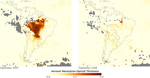
New NASA research shows a sharp decline in the amount of smoke over the Amazon during the 2008 burning season, coinciding with a drop in deforestation reported last week by Carlos Minc, Brazil's Environment Minister. Analyzing the aerosol concentrations over the Amazon each September from the past four burning seasons using the Ozone Monitoring Instrument on NASA's Aura satellite, atmospheric scientist Omar Torres of Hampton University and several colleagues found a dramatic decline in airborne particular matter in 2008, indicating reduced incidence of fire in the region. Fire in the Amazon is primarily used by humans for land-clearing to establish cattle pasture, which now accounts for the vast majority of land-use change in the world's largest rainforest.  …

NASA images show huge drop in Amazon fires in 2008

Wind + water = untapped energy: An abundance of power exists above Earth's oceans, study finds

image  (PhysOrg.com) -- Wind energy over the planet's oceans is a vastly underutilized renewable resource, according to UC Irvine researchers.

At 80 meters above the ocean - the typical wind turbine height - more than 50 percent more power is available than at 10 meters, the height important to the shipping industry upon which previous wind estimates were made.

Though Europe has led the development of offshore wind farms, conditions make U.S. coastal oceans prime for strong winds: The air is stable, and the water is cold, notes Charlie Zender, study co-author and Earth system science associate professor.

"In the midlatitudes, you find these stable environments where air really takes off and accelerates rapidly as you move away from the ocean's surface," he says. "There's a lot of power in the wind. The more we compare it to other energy sources, the more I'm impressed." …

Wind + water = untapped energy: An abundance of power exists above Earth's oceans, study finds

Technorati Tags: ,,

Irish 'energy for nothing' gizmo fails jury vetting

image By DICK AHLSTROM, Science Editor

A MUCH-TRUMPETED plan for limitless supplies of free energy has been dashed by the revelation that something cannot be produced from nothing.

An Irish company had promised it could deliver non-polluting, virtually cost-free power but an international jury said yesterday it did not work.

However the verdict has not deterred the company, Steorn Ltd, from continuing to develop a magnetism-based technology it calls “Orbo”. “It is a disappointment, but we had seen this coming for quite a while,” chief executive Seán McCarthy said yesterday.

“The jury hasn’t found they support the claims. We would dispute that.”

Based in Dublin’s Docklands near the O2 and employing 22 people, Steorn made international headlines almost three years ago when it claimed to have discovered a way to get more energy out of a gizmo than it put in. The excess, they said, could be used to power a mobile phone, run a fridge or make an MP3 player go.

Scientists doubted the claims and, when the company resisted calls to release precise details of how Orbo worked, it asked an international panel of experts to adjudicate on the device.

Steorn organised a panel of 22 independent scientists and engineers from Europe and North America chaired by Ian MacDonald, emeritus professor of electrical engineering at the University of Alberta.

“The situation was we had engaged them in February 2007 and went through a process with them,” Mr McCarthy said. Two years have passed however and the jury clearly decided that enough was enough.

It posted an announcement on its website http://stjury.ning.com that it was disbanding.

“The unanimous verdict of the jury is that Steorn’s attempts to demonstrate the claim have not shown the production of energy,” it stated. “The jury is therefore ceasing work.” …

Irish 'energy for nothing' gizmo fails jury vetting

Technorati Tags: