By Katie Drummond Email Author, November 18, 2009
The dwindling Arctic ice cap has launched an international race for control of northern waters: Russia, Canada, Denmark, and even China are hustling to expand their military presence, plant flags and eye those 90 billion barrels of natural gas under the cap. Now the U.S. Navy’s getting ready for the thaw, with a strategic plan to maximize the U.S. stake up north.
The Navy’s Arctic Roadmap (.pdf), written by the recently launched Navy Task Force Climate Change (TFCC), opens with an acknowledgment that worldwide temperatures are on the rise — especially up north. “The Arctic is warming twice as fast as the rest of the globe. While significant uncertainty exists in projections for Arctic ice extent, the current scientific consensus indicates the Arctic may experience nearly ice-free summers sometime in the 2030s,” the document notes.
Then the Arctic Roadmap sets out a three-phase plan to secure U.S. interests in the Arctic. Because there’s a lot at stake under that melting cap: energy reserves, transport lanes and potential territory disputes.
It’s the latest in a series of efforts by the sea service to cope with climate change. Just last month, the Navy announced its intention to deploy “an energy-efficient ‘Great Green Fleet’ carrier strike group consisting of ships powered either by nuclear energy or biofuels with an attached air wing of fighter jets fueled entirely by biofuels,” Military.com’s Greg Grant reported. …
Thursday, November 19, 2009
In nod to global warming, Navy preps for ‘ice free’ Arctic
Thursday, September 3, 2009
Human-caused Arctic warming overtakes 2,000 years of natural cooling, “seminal” study finds
A Hockey Stick in Melting Ice
So reports the National Center for Atmospheric Research (NCAR), which coauthored the study to be published in Science Friday. [I'll put the link up when it's posted.] The Washington Post story notes:
The analysis, based on more than a dozen lake sediment cores as well as glacier ice and tree ring records from the Arctic, provides one of the broadest pictures to date of how industrial emissions have shifted the Arctic’s long-standing natural climate patterns. Coupled with a separate report on the region issued Wednesday by the World Wildlife Fund, the studies suggest human-induced changes could transform not only the Arctic but climate conditions across the globe.
“It’s basically saying the greenhouse gas emissions are overwhelming the system,” said David Schneider, a visiting scientist at the National Center for Atmospheric Research and one of the Science article’s co-authors. …
Human-caused Arctic warming overtakes 2,000 years of natural cooling, “seminal” study finds
Monday, July 27, 2009
Revealed: the secret evidence of global warming Bush tried to hide
Photos from US spy satellites declassified by the Obama White House provide the first graphic images of how the polar ice sheets are retreating in the summer. The effects on the world's weather, environments and wildlife could be devastating
By Suzanne Goldenberg and Damian Carrington
Graphic images that reveal the devastating impact of global warming in the Arctic have been released by the US military. The photographs, taken by spy satellites over the past decade, confirm that in recent years vast areas in high latitudes have lost their ice cover in summer months.
The pictures, kept secret by Washington during the presidency of George W Bush, were declassified by the White House last week. President Barack Obama is currently trying to galvanise Congress and the American public to take action to halt catastrophic climate change caused by rising levels of carbon dioxide in the atmosphere.
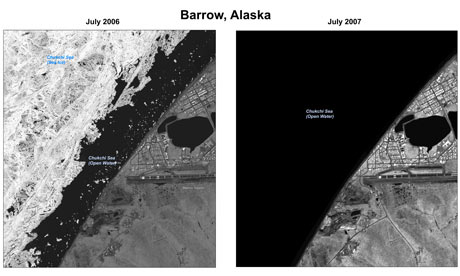
One particularly striking set of images - selected from the 1,000 photographs released - includes views of the Alaskan port of Barrow. One, taken in July 2006, shows sea ice still nestling close to the shore. A second image shows that by the following July the coastal waters were entirely ice-free.
The photographs demonstrate starkly how global warming is changing the Arctic. More than a million square kilometres of sea ice - a record loss - were missing in the summer of 2007 compared with the previous year.
Nor has this loss shown any sign of recovery. Ice cover for 2008 was almost as bad as for 2007, and this year levels look equally sparse. …
Revealed: the secret evidence of global warming Bush tried to hide
Sunday, July 19, 2009
Government rejects oil drilling deal in Alaska refuge
By Yereth Rosen
ANCHORAGE, Alaska (Reuters) - The U.S. Fish and Wildlife Service has rejected a controversial land trade that would have allowed oil and gas drilling in part of a national wildlife refuge in Alaska.
The service said it had made a preliminary decision to reject a Bush administration proposal in the works since 2004 to trade out land in the Yukon Flats National Wildlife Refuge so that it could be explored for oil.
Opposition from residents of Native American villages near the proposed drill sites, new information on geologic resources and a closer look at climate-change impacts led to the unexpected shift against going through with the land trade, officials said.
"The (environmental review) process worked, though it may have led us in a different direction than we had originally anticipated. Going into this effort, we did not anticipate the level of opposition we heard from some of the most affected communities within the Yukon Flats," Refuge Manager Rob Jess said in a statement. …
Wednesday, July 1, 2009
Ice911: Cool solutions for an overheated world
Global climate change is occurring. Are there any short-term yet reversible measures we can take to reduce future ecological damage while longer-term solutions are researched and developed?
Enter Ice911:
Ice911 is one such project, aimed at slowing down the melt of polar and glacial ice using ecologically friendly materials. These materials are designed and used in a way that allows them to later be removed if desired. These are important features to avoid any unintended ecological impacts.
Ice911 is an engineering approach to reduce the melting of the ice. It is a solution that can be rapidly implemented. It has the potential to slow down the melt, provide interim mammal habitat, and perhaps even rebuild the ice. …
Sunday, April 5, 2009
Black carbon linked to half of Arctic warming
Black carbon is responsible for 50 percent of the total temperature increases in the Arctic from 1890 to 2007 according to a study published in Nature Geoscience. Since 1890 the temperature in the Arctic has risen 1.9 degrees Celsius, linking black carbon to nearly an entire degree rise in Celsius or almost two degrees Fahrenheit.
Black carbon, a particulate air pollutant, is formed by-way of the incomplete combustion of fossil fuels, biofuels, and biomass. In places like Asia black carbon is usually produced by burning wood, coal, or cow dung for cooking or heating. In America and Europe, the use of diesel contributes heavily to black carbon. In total the destruction of forests and savannah by burning is the largest contributor of black carbon.
Black carbon is a double-whammy in terms of climate change: when in the atmosphere dark carbon particulates absorb sunlight and emit it as heat and after falling back to the earth black carbon can darken snow and ice, reducing their ability to reflect sunlight, thereby accelerating melting.
The study conducted by Drew Shindell of the NASA Goddard Institute for Space and Greg Faluvegi of Columbia University also found that the Arctic is most sensitive to black carbon produced within the middle latitudes of the Northern Hemispheres. A previous study had shown that 25 to 35 percent of the world's black carbon emissions come from China and India alone: two nations whose latitude lies at least partly in the sensitive zone.
“Climate conditions in the Arctic are rapidly deteriorating,” said Rafe Pomerance, president of Clean Air - Cool Planet. “This study reinforces the opportunity to control short-lived forcers of global warming including black carbon, methane and tropospheric ozone in order to slow the rate of warming in the Arctic. We cannot afford to allow the shrinkage of the Greenland ice sheet to accelerate.”
…
Black carbon linked to half of Arctic warming
Sunday, March 22, 2009
Arctic nations link polar bear survival to climate protection
TROMSO, Norway, March 20, 2009 (ENS) - Five nations obliged by treaty to conserve polar bears have resolved to link the future of the species to urgent global action on climate change.
The polar bear range states - Canada, Denmark/Greenland, Norway, Russia and the United States - in 1973 signed the legally binding Agreement on the Conservation of Polar Bears, agreeing to protect the white bears and their habitat. They gathered in Tromso for three days this week, their first meeting since 2007.
"We are very encouraged by the final declaration from this meeting,” says Geoff York, polar bear coordinator for WWF International’s Arctic Program.
"We were concerned that some countries were lagging behind the others in their commitment to dealing with climate change, but ultimately, the parties recognized climate change as the primary threat to the future well-being of polar bears," said York.
"They also recognized formally "the urgent need for an effective global response that will address the challenges of climate change,” to be addressed at gatherings such as the meeting of the UN Framework Convention on Climate Change in December in Copenhagen where a successor agreement to the Kyoto Protocol is expected to be finalized. …
Arctic Nations Link Polar Bear Survival to Climate Protection
Saturday, February 14, 2009
Climate change likely to be more devastating than experts predicted, warns top IPCC scientist
(Stanford University) Without decisive action, global warming is likely to accelerate at a much faster pace and cause more environmental damage than predicted, says Stanford scientist Chris Field, a leading member of the Nobel Prize-winning Intergovernmental Panel on Climate Change.
Field warns that higher temperatures could ignite tropical forests and melt the Arctic tundra, releasing billions of tons of greenhouse gas that could raise temperatures even more -- a vicious cycle that could spiral out of control.
Climate change likely to be more devastating than experts predicted, warns top IPCC scientist
Friday, January 30, 2009
Pole-to-pole flight finds CO2 piling up over Arctic
By Timothy Gardner
NEW YORK (Reuters) - Scientists who flew a modified corporate jet from pole to pole to study how greenhouse gases move found carbon dioxide piling up over the Arctic, but also higher than expected levels of oxygen over the Antarctic.
The three-week, $4.5 million mission this month in a specially equipped Gulfstream V jet was the first of five flights planned over the next three years by a Harvard University-led project based in Colorado.
The research will help scientists understand how carbon is stored in the planet and how much carbon dioxide, the main greenhouse gas, is released by cars and factories burning fossil fuels, or by the burning of forests.
The jet, which flew from Colorado to the Arctic and back south to the Hawaiian Islands toward Antarctica, is equipped to suck in air samples and test them in a laboratory aboard.
Initial observations point to a carbon dioxide build up over the Arctic, which may be due to industrial pollution and burning of trees over the last few centuries, scientists told reporters on Thursday in a teleconference about the mission.
Pole-to-pole flight finds CO2 piling up over Arctic