
By Sarah McBride
October 30, 2010Mercy Vaughn crouches over a young tortoise peeking out from its burrow near a creosote bush in California's Mojave Desert.
The area is home to rare species, including the threatened desert tortoise. But a giant solar plant is under construction in the vast wilderness area.
To help save the animal, the company building the plant, BrightSource Energy, had to agree to a lot of conditions, including reptile relocation.
Vaughn, a biologist from Texas, and her colleague Peter Woodman are leading a team of 50 biologists hired to survey the site over and over before construction begins. They have to keep track of every single tortoise.
"This is one that was walking down the middle of the road when it was spotted by one of the monitors," Woodman says. "Luckily, we've got a radio transmitter on it now."
He's looking at an adult female tortoise; she's about the size of a dinner plate, and the transmitter is glued to her shell. It almost looks like a stray twig. …
The tortoises can't stay where construction crews might harm them, so the biologists are moving them to pens to ride out the desert winter. In the spring, they'll try relocating them to the wild.
BrightSource is spending more than $40 million to protect plants and wildlife. That includes buying acres of land to keep as nature preserves. …
Tuesday, November 16, 2010
The tortoise and the solar plant


Monday, April 26, 2010
Nudges gone wrong: A program designed to reduce energy consumption persuaded some Republicans to consume more
By Ray Fisman
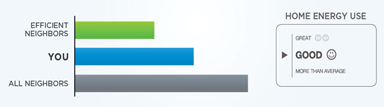
Posted Friday, April 23, 2010, at 10:01 AM ETIt's a sad statistical reality: Half of us are below average. But that doesn't stop most of us from clinging to delusions of superiority: We like to believe we're better-looking, smarter, funnier, and more honest than those around us. Now and then, when presented with evidence of our shortcomings, we set to work catching up with—and getting ahead of—the Joneses. A decade ago, I caved in and bought a cell phone when I read that the median American owned one.
Psychologists and behavioral economists hope that our tendency to benchmark our own achievements using the performance of others might provide a way to encourage Americans to become better citizens. Can the fear of being below average persuade us to reduce our electricity consumption, increase our charitable contributions, and otherwise compete to be better citizens?
One problem with this approach is that we all define "better" differently, as a new study emphasizes. UCLA economists Dora Costa and Matthew Kahn analyzed the impact of an energy-conservation program in California that informed households about how their energy use compared with that of their neighbors. While the program succeeded in encouraging Democrats and environmentalists to lower their consumption, Republicans had the opposite reaction. When told of their relative thrift, they started cranking up the thermostat and leaving the lights on more often. …
Why would some energy-conscious Republicans all of a sudden become power hogs? One explanation is that many conservatives don't believe that burning energy harms the planet, so when they learn that they're better than average, they become less vigilant about turning the lights off. That is, they're simply moving closer to what they now know is the norm (what psychologists call the boomerang effect). Costa and Kahn also look for guidance from the patron saint of right-wing fundamentalists, Rush Limbaugh, who encouraged his listeners to turn on all their lights during Earth Hour. Costa and Kahn suggest that ardently right-wing electricity customers might respond to paternalistic nudges by burning more energy, just to thumb their noses at Big Brother. …
Friday, November 6, 2009
Scientists launch effort to sequence the DNA Of 10,000 vertebrates

Scientists have an ambitious new strategy for untangling the evolutionary history of humans and their biological relatives: Create a genetic menagerie made of the DNA of more than 10,000 vertebrate species. The plan, proposed by an international consortium of scientists, is to obtain, preserve, and sequence the DNA of approximately one species for each genus of living mammals, birds, reptiles, amphibians and fish. …
Scientists Launch Effort To Sequence The DNA Of 10,000 Vertebrates
Wednesday, September 2, 2009
Amazon deforestation to fall 30% in 2009
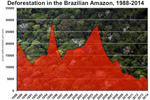
Deforestation is the Brazilian Amazon is likely to fall between 8,500 square kilometers (3,088 square miles) and 9,000 sq km (3,474 sq mi) for the 12 months ended July 31, 2009, a reduction of 29-37 percent from last year, reports Brazil's Environment Minister Carlos Minc. If the estimate is confirmed by high resolution satellite data to be published later this year, the rate of forest loss for 2008-2009 would be the lowest since annual record-keeping began in the 1980s. …
Amazon deforestation to fall 30% in 2009
Monday, August 31, 2009
New Amazonian reserve saves over a million acres in Peru
On August 27th Peru's Ministry of the Environment approved the creation of the Matses National Reserve to protect the region's biodiversity, ensure its natural resources, and preserve the home of the Matses indigenous peoples (known as the Mayorunas in Brazil). The park is 1,039,390 acres (or 420,626 hectares) of lowland Amazonian rainforest in eastern Peru. The park is the culmination of over a decade of work by the local non-profit CEDIA (the Center for the Development of the Indigenous Amazonians) funded in part by the Worldland Trust. …
New Amazonian reserve saves over a million acres in Peru
Sunday, August 23, 2009
E. O. Wilson: We must save the living environment
Saving Earth's biodiversity will take nothing less than an IPCC for species, says the world's leading biologist and ant guru

By Roger Highfield
What's this idea all about?
It sounds immodest but I call it Wilson's law. It says that if you save the living environment, you will automatically save the physical environment. But if you only try to save the physical environment, you will lose them both. That is a defensible law.
So we need a major rethink?
When we talk about the world going green, the media and the public think of pollution or fresh-water shortage. They understand, and want to do something. But that is the physical world; concern for the living environment has been slow to take off, as Julia Marton-Lefèvre, head of the International Union for Conservation of Nature (IUCN), will agree. We are not making the headway we should be in preventing the destruction of ecosystems and species. I have written book after book arguing that if we don't start caring about holding onto them, we will have big problems - some unforeseeable. Most Americans have only the vaguest notion about any of that, even though they can talk intelligently about climate change. Yet when it comes to the living world they are in danger of losing something they scarcely understand. …
E. O. Wilson: We must save the living environment
Wednesday, August 19, 2009
Save our rainforest friends!

August 2009 — Lockhard Conservation Toys have created a loveable, ethical and educational range called Rainforest Friends. The super cuddly large toy collection is designed to raise awareness and funds for the plight of our much loved yet critically endangered species that live in the worlds most threatened habitats.
Every Rainforest Friend sold benefits the World Land Trust whose patron is Sir David Attenborough. The money raised helps protect our diminishing rainforests, to ensure a safe future for some of our best-loved animals. World Land Trust works with local people to purchase and protect their rainforest habitats. …
Rainforest Friends, loveable toys retail at £28.95 and are available at www.saveourfriends.co.uk.
Monday, January 5, 2009
Bush leaves legacy of ocean protection
It's strange that Bush would go to such great lengths to protect ocean ecosystems, while at the same time assiduously dismantling environmental protections in the US. --Jim
Renee Schoof, McClatchy Newspapers

WASHINGTON — President George W. Bush on Tuesday will create three new marine monuments in the Pacific Ocean to protect the deepest place on Earth, some of the last pristine corals and sanctuaries for vanishing marine species.
The three monuments — in the Mariana Islands in the western Pacific, the Rose Atoll off American Samoa and remote islands in the central Pacific — cover 195,280 square miles, the largest protected area of ocean.
Conservationists and the White House declared a new era for protection of unique and endangered places in the ocean, opportunities of scientific discovery and an important effort to protect some of the last places where the ocean still looks like the abundant world of centuries or even thousands of years past.
The Marianas Marine National Monument will protect the Mariana Trench, the deepest place on Earth — deeper than Mount Everest is high and explored for the first time only in 1960. The three monuments also protect corals and the ecosystems that include large migratory, resting and feeding sea birds, and endangered animals such as sea turtles.
"To me and the president and first lady, one of the things that really affected us in learning from the scientists is these locations are truly among the last pristine areas in marine environments on Earth," White House Council on Environmental Quality chairman James Connaughton told reporters Monday. "This is a huge day for marine conservation."
Bush leaves legacy of ocean protection

 Posts
Posts


