Showing posts with label biodiversity. Show all posts

Friday, April 2, 2010

James Cameron, in real life, fights to save indigenous groups from massive dam construction in Brazil

By Jeremy Hance, www.mongabay.com
April 01, 2010

After creating a hugely successful science-fiction film about a mega-corporation destroying the indigenous culture of another planet, James Cameron has become a surprisingly noteworthy voice on environmental issues, especially those dealing with the very non-fantastical situation of indigenous cultures fighting exploitation.

This week Cameron traveled to Brazil for a three-day visit to the Big Bend (Volta Grande) region of the Xingu River to see the people and rainforests that would be affected by the construction of the Belo Monte Hydroelectric Dam. Long-condemned by environmentalists and indigenous-rights groups, the dam would destroy 500 square kilometers of pristine rainforest and force the relocation of some 12,000 people.

"For people living on the banks of the river, as they have for thousands of years, the damage done (by the dam) would destroy their way of life," Cameron said in a press conference following his trip, according to Agencia EFE. He asked the Lula Administration of Brazil to reconsider their decision to build the dam.

"There are always other solutions when good leaders play their part to solve a problem," added Cameron.

Earlier at a Forum in Manuas, Cameron pointed to a WWF Brazil study: "If Brazil were to invest a fraction of the cost of the dam in energy efficiency it could generate 14 times the energy of the Belo Monte Dam and have electricity savings of up to US$19 billion."

During his trip, Cameron met with several representatives of indigenous groups including the Juruna, Xipaia, Xikrin Kayapó. …

James Cameron, in real life, fights to save indigenous groups from massive dam construction in Brazil

Wednesday, August 26, 2009

Launch for amphibian 'life raft'

 Dendrobates azureus - R.A.Mittermeier

By Richard Black, Environment correspondent, BBC News website

Conservationists have launched a new initiative aimed at safeguarding the world's amphibians from extinction.

The Amphibian Survival Alliance will bring together existing projects and organisations, improving co-ordination, scientific research and fund-raising.

About a third of amphibian species are threatened with extinctions.

A two-day summit held last week in London identified the two main threats as destruction of habitat and the fungal disease chytridiomycosis.

"The world's amphibians are facing an uphill battle for survival," said James Collins, co-chair of the Amphibian Specialist Group (ASG) co-ordinated by the International Union for the Conservation of Nature (IUCN).

"By far the worst threats are infectious disease and habitat destruction, so the Alliance will focus on these issues first." ...

"If we want to stop the amphibian extinction crisis, we have to protect the areas where amphibians are threatened by habitat destruction," said Claude Gascon, the Amphibian Specialist Group's other co-chair.

"One of the reasons amphibians are in such dire straits is because many species are only found in single sites and are therefore much more susceptible to habitat loss." …

Launch for amphibian 'life raft'

Wednesday, August 19, 2009

Save our rainforest friends!

The Rainforest Friends ethical range of cuddly, super-large toys are our way of showing we care about the plight of endangered animals struggling to survive in the Rainforest today. With every Rainforest Friend toy sold, we’ll make a contribution on your behalf to the World Land Trust charity whose patron is Sir David Attenborough.

August 2009 — Lockhard Conservation Toys have created a loveable, ethical and educational range called Rainforest Friends. The super cuddly large toy collection is designed to raise awareness and funds for the plight of our much loved yet critically endangered species that live in the worlds most threatened habitats.

Every Rainforest Friend sold benefits the World Land Trust whose patron is Sir David Attenborough. The money raised helps protect our diminishing rainforests, to ensure a safe future for some of our best-loved animals. World Land Trust works with local people to purchase and protect their rainforest habitats. …

Rainforest Friends, loveable toys retail at £28.95 and are available at www.saveourfriends.co.uk.

Save Our Rainforest Friends!

Thursday, July 30, 2009

Ecological restoration substantially boosts biodiversity and ecosystem services

A new analysis reports that ecological restoration generally deliver benefits for both conserving biodiversity and supporting human livelihoods, but does not completely reverse degradation caused by humans.

The research, published in Science, examined 89 studies and found that ecological restoration increased provision of biodiversity and ecosystem services by 44 percent and 25 percent respectively. Values of both, however, remained lower in restored than in intact reference ecosystems.

Still, Jose Rey Benayas and colleagues are encouraged that restoration projects could become increasingly viable under emerging payments for environmental services schemes like the Reducing Emissions from Deforestation and Degradation (REDD) mechanism proposed for a post-Kyoto climate agreement. Such initiatives, which could compensate developing countries for protecting and restoring ecosystems, could simultaneously deliver benefits to the environment and local communities. …

Ecological restoration substantially boosts biodiversity and ecosystem services

Wednesday, July 15, 2009

Longest insect migration revealed

Globe skimmers (Pantala flavescens)

Matt Walker, Editor, Earth News 

Every year, millions of dragonflies fly thousands of kilometres across the sea from southern India to Africa.

So says a biologist in the Maldives, who claims to have discovered the longest migration of any insect.

If confirmed, the mass exodus would be the first known insect migration across open ocean water.

It would also dwarf the famous trip taken each year by Monarch butterflies, which fly just half the distance across the Americas.

Biologist Charles Anderson has published details of the mass migration in the Journal of Tropical Ecology.

Each year, millions of dragonflies arrive on the Maldive Islands, an event which is well known to people living there.

"But no-one I have spoken to knew where they came from," says Anderson, an independent biologist who usually works with organisations such as the Maldivian Marine Research Centre to survey marine life around the islands. …

The dragonflies are clearly migrating from India across the open sea to the Maldives, says Anderson.

"That by itself is fairly amazing, as it involves a journey of 600 to 800km across the ocean," he says.

Quite how they do it was a bit of a mystery, as in October at least they appear to be flying against the prevailing winds. …

Longest insect migration revealed

Technorati Tags: ,

Friday, June 12, 2009

Amazon deforestation leads to development 'boom-and-bust'

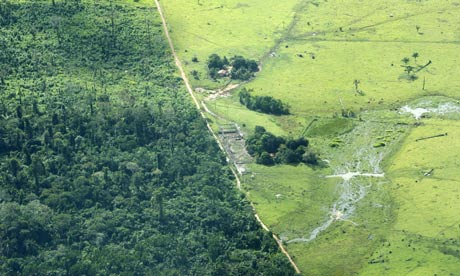
Aerial view of cattle farm in Amazonian deforested jungle close to Maraba

By Alok Jha

Chopping down the Amazon rainforest to make way for crops or cattle has no economic or social benefit for local people in the long term, according to a major new study.

The finding undercuts the argument that deforestation, which causes 20% of the globe's greenhouse gas emissions, leads to long-term development.

Conservationists showed communities develop rapidly but temporarily when forests are cleared. But rates of development quickly fall back below national average levels when the loggers move on and local resources near depletion.

More than 155,000 square kilometres of Amazonian rainforest in Brazil have been cleared for timber or burned to make way for agricultural land since 2000. Every year, around 1.8m hectares are destroyed — a rate of four football fields every minute. The Amazonian rainforest is one of the most biodiverse regions in the world, guarding against climate change by absorbing CO2 and maintaining geochemical cycles.

But some argue that local communities, which are among the poorest in Brazil, should be able to benefit from the local resources by creating farms or logging the trees. To calculate these potential benefits of deforestation for local communities, a team of international scientists analysed the life expectancy, literacy and income of people living in 286 areas around the Brazilian Amazon.

Their results, published today in Science, showed that the quality of life for local communities improved rapidly when a forest first cleared. "The monthly average income started out at 74 Reals per month," said Rob Ewers of the department of life sciences at Imperial College London, a member of the study team. "Then it went up to as much as 196 Reals per month in the middle [of the deforested area] and then to 82 once the resource is gone. Literacy went from 68% at the frontier [of the forest] up to a maximum of 83% then dropped down to 69%." …

Amazon deforestation leads to development 'boom-and-bust.'

Saturday, January 31, 2009

Many new species discovered in hidden oasis with help of Google Earth

 Scientific surveying Mount Mabu -- Mozambique - found a wealth of wildlife including Pygmy Chamelons. (Credit: Julian Bayliss / Kew)

Space may be the final frontier, but scientists who recently discovered a hidden forest in Mozambique show the uncharted can still be under our noses. Scientists used Google Earth to identify a remote patch of pristine forest. An expedition to the site discovered new species of butterfly and snake, along with seven Globally Threatened birds.

The team were browsing Google Earth – freely available software providing global satellite photography – to search for potential wildlife hotspots. A nearby road provided the first glimpses of a wooded mountain topped by bare rock. However, only by using Google Earth could the scientists observe the extent of woodland on the other side of the peak. This was later discovered to be the locally known, but unmapped, Mount Mabu. Scientific collections and literature also failed to shed light on the area.

“This is potentially the biggest area of medium-altitude forest I’m aware of in southern Africa, yet it was not on the map”, related Jonathan Timberlake from the Royal Botanic Gardens, Kew (RBG Kew), who led the expedition. “Most Mozambicans would not even have recognised the name Mount Mabu.”

Many New Species Discovered In Hidden Oasis With Help Of Google Earth
Sat, 31 Jan 2009 05:00:00 GMT

Technorati Tags:

Thursday, January 1, 2009

Shade-grown coffee benefits more than birds

Shade coffee farms, which grow coffee under a canopy of multiple tree species, not only harbor native birds, bats and other beneficial creatures, but also maintain genetic diversity of native tree species and can act as focal points for tropical forest regeneration. (Credit: Image courtesy of University of Michigan)

ScienceDaily (Dec. 31, 2008) — Here's one more reason to say "shade grown, please" when you order your morning cup of coffee. Shade coffee farms, which grow coffee under a canopy of multiple tree species, not only harbor native birds, bats and other beneficial creatures, but also maintain genetic diversity of native tree species and can act as focal points for tropical forest regeneration.

The finding comes from a study published by University of Michigan researchers Shalene Jha and Christopher Dick in the Dec. 23 issue of the journal Current Biology.

Jha, a graduate student whose main interest is insects, initially wanted to find out whether shade coffee farms nurture native pollinators such as stingless bees. When she began her fieldwork in Chiapas, Mexico, she focused on a particular tree, Miconia affinis, which is pollinated by an unusual method known as buzz pollination. In order to release pollen from its flowers, bees grab hold and vibrate their flight muscles, shaking the pollen free. Non-native species such as Africanized honeybees don't perform buzz pollination, but native bees do, said Jha, "so I thought Miconia, which requires buzz pollination and is common both in forests and on coffee farms, could be a bio-indicator of how well native bees are pollinating native plants."

Shade Coffee Benefits More Than Birds
Thu, 01 Jan 2009 01:00:00 GMT

Technorati Tags: ,

Wednesday, November 26, 2008

Networks of small habitat patches can preserve urban biodiversity

Sets of small and seemingly insignificant habitat patches that are within reach for mobile species may under certain circumstances, as a group, provide an acceptable alternative to larger and contiguous habitats. This finding can make preservation of important ecological functions possible even in urban and other heavily exploited areas.

The study by Dr. Erik Andersson and Dr. Örjan Bodin at the Department of Systems Ecology, and Stockholm Resilience Centre, both at Stockholm University, is unique in the sense that they empirically test and verify an often used modelling approach where habitat fragments are seen as individual nodes in larger networks of interconnected habitat patches.

According to the study, sets of small habitat patches can host species that require much larger habitat patches for their daily needs than what each patch itself can provide. Many species are actually capable of moving back and forth between neighbouring patches, given that they are not perceived as being too far apart. Thus, many species are able to make use of the total of the habitat fragments in the network instead of relying on the individual habitat patches for their persistence.

Networks Of Small Habitat Patches Can Preserve Urban Biodiversity
Mon, 24 Nov 2008 10:00:00 GMT