Showing posts with label algae. Show all posts

Thursday, February 18, 2010

Ocean geoengineering scheme no easy fix for global warming

This map displays simulated additional surface warming (in Celsius) for the year 2100 caused by the temporary use of artificial upwelling in the green areas for the time period 2011-2060. Credit: IFM-GEOMAR

(National Oceanography Centre, Southampton (UK)) Pumping nutrient-rich water up from the deep ocean to boost algal growth in sunlit surface waters and draw carbon dioxide down from the atmosphere has been touted as a way of ameliorating global warming. However, a new study led by Professor Andreas Oschlies of the Leibniz Institute of Marine Sciences in Kiel, Germany, pours cold water on the idea.

"Computer simulations show that climatic benefits of the proposed geo-engineering scheme would be modest, with the potential to exacerbate global warming should it fail," said study co-author Dr Andrew Yool of the National Oceanography Centre, Southampton (NOCS). …

The aim would be to mimic the effects of natural ocean upwelling and increase drawdown of atmospheric carbon dioxide by phytoplankton through the process of photosynthesis. Some of the sequestered carbon would be exported to the deep ocean when phytoplankton die and sink, effectively removing it from the system for hundreds or thousands of years.

A previous study, of which Yool was lead author, used an ocean general circulation model to conclude that literally hundreds of millions of pipes would be required to make a significant impact on global warming. But even if the technical and logistical difficulties of deploying the vast numbers of pipes could be overcome, exactly how much carbon dioxide could in principle be sequestered, and at what risk?

In the new study, the researchers address such questions using a more integrated model of the whole Earth system. The simulations show that, under most optimistic assumptions, three gigatons of carbon dioxide per year could be captured. This is under a tenth of the annual anthropogenic carbon dioxide emissions, which currently stand at 36 gigatons per year. A gigaton is a million million kilograms. … when the simulated pumps were turned off, the atmospheric carbon dioxide levels and surface temperatures rose rapidly to levels even higher than in the control simulation without artificial pumps. This finding suggests that there would be extra environmental costs to the scheme should it ever need to be turned off for unanticipated reasons. …

Ocean geoengineering scheme no easy fix for global warming

Tuesday, August 18, 2009

Some algae biofuel news

Sustainable Green Technologies (SGT) a start-up company in Escondido, California announced today that it has discovered a highly effective and low cost way to massively increase algal oil production. Metabolic engineering research conducted at SGT over the past two years paid off when SGT scientists uncovered the elusive and long sought after “lipid trigger” in green algae. Usually algae store excess harvested solar energy in the form of starch and in smaller amounts as lipid droplets within their cells. But under certain ideal conditions, many microalgae appear to flip a switch to turn on massive production and storage of oils instead of starch. The true nature of this metabolic switch as well as the conditions which activate (or trigger) the switch remained elusive. Now SGT is able to activate the switch at will and to create “obese algae.” This breakthrough technology supports the U.S. Advanced Energy Initiative - which seeks to diversify the U.S. energy portfolio and to reduce dependence on foreign oil.

“We uncovered the algae oil lipid trigger almost by accident,” notes Dr. Elmar Schmid, SGT’s CSO. "We were looking for new and rational uses of a waste stream from our biohydrogen technology. We found the waste from our biohydrogen system sparked tremendous growth of our green algae, and more importantly, massively increased lipid production and storage within our algae. In other words, our algae became obese within one week! We now have a highly efficient, cost-effective way of producing large amounts of algae oils for biodiesel fuel production. On top of that, we can produce clean biohydrogen from the resulting biodiesel refinery waste!” exclaims Dr. Schmid. …

Calif. startup announces algae breakthrough

A Cambridge, Massachusetts-based start-up has emerged from stealth operations with a process that it says can produce transportation fuel from sunlight and carbon dioxide (CO2) without the need for growing biomass like corn, switchgrass or algae. Joule Biotechnologies, Inc. says it has achieved a bioengineering breakthrough that can harnesses sunlight to directly convert CO2 into liquid energy. Joule said its uses highly-engineered photosynthetic organisms in a process that requires no agriculture land or fresh water to produce 20,000 gallons of renewable ethanol or hydrocarbons per acre annually. The company revealed few details claiming the need to protect trade secrets at this point in time, but promised that its first product will be available in 2010. Joule's chief executive Bill Sims told the Wall Street Journal: "We're not a biofuel company, because biofuels are biomass-derived; our technology leverages a highly synthetic organism to create transportation fuels and chemicals. We don't have an intermediary that has to be grown or transported, it's a direct-to-product process."

Sustainable Business News

Technorati Tags: ,

Spokane Co. high-phosphate detergent ban working

Lake Spokane (Long Lake)

THE ASSOCIATED PRESS

SPOKANE, Wash. -- A year after Spokane County became the only place in the country to ban phosphate-laden dishwashing detergents, new data shows the effort appears to be working.

Water coming into Spokane's sewage plant during the first 12 months of the ban had nearly 11 percent less phosphorus than the annual average the previous three years, the Spokesman-Review reported.

Mike Coster, the plant's operations superintendent, says the new law won't have much of an effect on water flowing from the plant into the river since treatment removes much of the phosphorous.

But it will have a bigger impact on homes on septic or drain field systems, where water and phosphorous filter back into groundwater, he said.

"Any phosphorus reduction you can see there is going to have benefit to the river," Coster said. "It's not the total answer, but it's one step."

Spokane County, along with Whatcom County, prohibits the sale of dishwasher detergents with more than 0.5 percent phosphorous. That ban will extend to the rest of the state next July. …

Spokane Co. high-phosphate detergent ban working

Technorati Tags: ,

Tuesday, August 11, 2009

BP signs multi-year development agreement with Martek Biosciences

algae photo 

 photo: Rosa y Dani via flickr

Another fossil fuel company investing in algae: BP has announced that it will be partnering with Martek Biosciences to work on advancing development of conversion of sugars into biodiesel, using Martek's "unique algae-based technologies and intellectual property."…

BP Gets Into Algae: Signs Multi-year Development Agreement with Martek Biosciences

Technorati Tags: ,

Tuesday, August 4, 2009

Plankton power to build algae biofuel facility on Cape Cod

plankton power photo

photo: Plankton Power

In about a year Cape Cod will have its first algae biofuel facility. Plankton Power and the Regional Technology Development Corp. have announced that they have formed a public-private consortium to build a pilot-scale biorefinery at the Massachusetts Military Reservation in Bourne. …

Plankton Power to Build Algae Biofuel Facility on Cape Cod

Technorati Tags: ,

Thursday, July 16, 2009

Dow Chemical partners with Algenol Biofuels to build pilot biorefinery

 algae photo

photo: Algenol Biofuels

Though it was announced over two weeks ago, perhaps because of Exxon's backing of Synthetic Genomics, Dow Chemical's backing of Algenol Biofuels is getting a bit more play. Together they will develop a pilot-scale algae biorefinery at Dow's Freeport, Texas manufacturing site: Technology Review describe the project:

CO2 From Dow's Operations Feed Into Bioreactors
The plant will consist of 3,100 horizontal bioreactors -- troughs covered with semi-transparent film, filled with salt water pumped in from the ocean, in which the algae grows -- each of which is about 5' wide and 50' long. The algae grown in these will be able to produce about 100,000 gallons of ethanol annually. CO2 from Dow's nearby operations will be fed into the bioreactors.

The thing with Algenol's method of producing algae biofuels is that it has modified the blue-green algae to directly produce ethanol through photosynthesis. What's more is that Algenol doesn't have to harvest the algae to extract the ethanol, simplifying the process and reducing costs. …

Dow Chemical Partners with Algenol Biofuels to Build Pilot Biorefinery

Technorati Tags: ,

Tuesday, July 14, 2009

Exxon to invest $600 million in making fuel from algae

And this is after GreenFuel went under. Hmm…

A fallen branch lays outside the Exxon Mobil refinery in Baytown, Texas September 15, 2008. REUTERS / Jessica Rinaldi

By Tom Bergin

LONDON (Reuters) - Exxon Mobil Corp has agreed to invest possibly more than $600 million in a venture to develop biofuels from algae, the oil major, which previously dismissed renewable energy as uneconomic, said on Tuesday.

Exxon said in a statement it was forming a research and development alliance with Synthetic Genomics Inc., a privately held company focused on gene-based research.

"Algae-based fuels could help meet the world's growing demand for transportation fuel while reducing greenhouse gas emissions," said Michael Dolan, senior vice president of Exxon. …

Exxon to invest $600 million in making fuel from algae

Technorati Tags: ,

Thursday, June 4, 2009

Phosphorus famine: the threat to our food supply

This underappreciated resource--a key component of fertilizers--is still decades from running out. But we must act now to conserve it, or future agriculture could collapse

Jen Christiansen

By David A. Vaccari   

As complex as the chemistry of life may be, the conditions for the vigorous growth of plants often boil down to three numbers, say, 19-12-5. Those are the percentages of nitrogen, phosphorus and potassium, prominently displayed on every package of fertilizer. In the 20th century the three nutrients enabled agriculture to increase its productivity and the world’s population to grow more than sixfold. But what is their source? We obtain nitrogen from the air, but we must mine phosphorus and potassium. The world has enough potassium to last several centuries. But phosphorus is a different story. Readily available global supplies may start running out by the end of this century. By then our population may have reached a peak that some say is beyond what the planet can sustainably feed.

Moreover, trouble may surface much sooner. As last year’s oil price swings have shown, markets can tighten long before a given resource is anywhere near its end. And reserves of phosphorus are even less evenly distributed than oil’s, raising additional supply concerns. The U.S. is the world’s second-largest producer of phosphorus (after China), at 19 percent of the total, but 65 percent of that amount comes from a single source: pit mines near Tampa, Fla., which may not last more than a few decades. Meanwhile nearly 40 percent of global reserves are controlled by a single country, Morocco, sometimes referred to as the “Saudi Arabia of phosphorus.” Although Morocco is a stable, friendly nation, the imbalance makes phosphorus a geostrategic ticking time bomb.

In addition, fertilizers take an environmental toll. Modern agricultural practices have tripled the natural rate of phosphorus depletion from the land, and excessive runoff into waterways is feeding uncontrolled algal blooms and throwing aquatic ecosystems off-kilter. While little attention has been paid to it as compared with other elements such as carbon or nitrogen, phosphorus has become one of the most significant sustainability issues of our time. ...

Phosphorus Famine: The Threat to Our Food Supply

Friday, May 29, 2009

Cost viability and algae

GreenFuel has called it quits.  I haz a sad.

Posted by Heading Out on May 29, 2009

Robert Rapier recently drew attention to the demise of GreenFuel Technologies, the company founded on ideas from MIT and Harvard and supported by millions of dollars in venture capital funding. One of the creative ideas that the company has was to located their plant at existing power stations so that the carbon dioxide generated in the flue gas could be fed into the bio-reactors holding the algae, with the gas also keeping the algae at an optimal growing temperature. It was a company that was in the vanguard of promoting the use of algae in both carbon dioxide collection and liquid fuels production.

The company, however, ran into problems in raising more money in the current climate, and with the technology. According to to a recent news report:

Getting the whole thing to run smoothly, though, was tougher than expected. GreenFuel could grow algae. The problem was controlling it. In 2007, a project to grow algae in an Arizona greenhouse went awry when the algae grew faster than they could be harvested and died off. The company also found its system would cost more than twice its target.

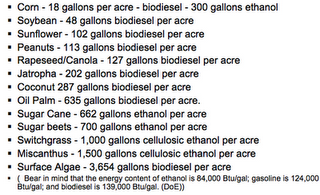
It is that latter part of the paragraph that is the more telling. When folk first consider using algae as a future fuel source, it is often because, when tabulated, algae can produce more fuel per acre per year, than any other crop.

Source Biodiesel - Growing a New Energy Economy - Greg Paul, Chelsea Green Publishing Company, 2005, 281 pages

However, getting what has been achieved in the short term into a production mode that sustains the same yield for year after year is not that easy. Nor is simply finding the best algae the only solution required for the problem.

Given the collapse of GreenFuel, it is perhaps useful to look at some of the things that need to be considered, if you are going to have a shot at a viable algae operation. …

Cost Viability and Algae

Technorati Tags: ,

Saturday, April 25, 2009

Aquatic Energy to open demo-scale algae biofuel facility in Louisiana

algae paste photo 

Algae paste, photo: Biofuels Digest

Lake Charles, Louisiana-based Aquatic Energy has announced that it is ready to move beyond its initial pilot-scale algae biofuel facility, and will be expanding to an 11-acre demonstration project using the company's open pond system, which is achieving yields on 2500 gallons per acre...

Aquatic Energy to Open Demo-Scale Algae Biofuel Facility in Louisiana

Technorati Tags: ,

Saturday, March 28, 2009

Algae biofuels: the hype, the hope, the promise

A typical raceway pond, National Renewable Energy Laboratory The Algae Biofuels World Summit concluded this week in San Francisco. I was on-hand and on assignment for Triple Pundit Monday at the day long pre-conference briefing featuring leaders in research, government, and business involved in pushing the infant industry toward commercial-scale production.

It was a sobering day for me, as it became clear that much of what is bandied about on blogs and in the mainstream media (to the extent algal biofuel research gets any coverage in the mainstream media) is wild-eyed optimism and pure hype. No, you can not produce 15,000 gallons of algae biofuel per acre per year; no, algae biofuel will not replace oil all by itself - and the list goes on.

The plain reality is that producing algae biofuel at a commercial scale is not a given, it will not be cheap or easy, and a lot more R&D needs to be done before any real hope of algae biofuel being more than an experimental or "boutique" fuel is realized. …

Algae Biofuels - The Hype, the Hope, the Promise

Technorati Tags: ,

Tuesday, March 10, 2009

The top 5 technologies that will save us from climate change

Algae Tube Picture

Dear Pablo: What do you believe are the top technologies that will help us overcome climate change?

First of all, the number one solution to climate change is not a technology at all; it is political will. As Thomas Friedman, the author of Hot, Flat, and Crowded said in a speech last week "change your leaders, not your light bulbs." …

1. Algae Biofuels

Algae, that green scum that grows in your pool when you forget to chlorinate it, can contain more than 50 percent lipids (fat). By feeding algae with nutrient-rich water (wastewater treatment plant effluent, for example) and carbon dioxide (the climate change-causing emissions from power plants) and exposing them to warmth and sunlight, they multiply rapidly (see image above). The lipids can then be extracted easily and used to create biodiesel fuel, which can replace or be mixed with regular diesel. The remaining material can be used as cattle feed, burned as a biomass fuel, or processed into methane by small organisms.

What could be better than a plant-based solution that uses waste materials (dirty water and CO2) and renewable resources (sunlight) to create both a transportation fuel and a heating fuel? Not much, which is why algae holds so much promise. Several companies, such as PetroSun and GreenFuel Technologies, are currently working on commercializing this technology. The Torres winery in Villafranca del Penedes, Spain is even operating an experimental facility that captures the emissions from wine fermentation to grow algae for making biofuels. …

The Top 5 Technologies That Will Save Us from Climate Change

Thursday, January 8, 2009

First flight of algae-fuelled jet

The biofuel's developers showcased its algal origins

A US airline has completed the first test flight of a plane partly powered by biofuel derived from algae.

The 90-minute flight by a Continental Boeing 737-800 went better than expected, a spokesperson said.

One of its engines was powered by a 50-50 blend of biofuel and normal aircraft fuel.

Wednesday's test is the latest in a series of demonstration flights by the aviation industry, which hopes to be using biofuels within five years.

The flight was the first by a US carrier to use an alternative fuel source, and the first in the world to use a twin-engine commercial aircraft (rather than a four-engine plane) to test a biofuel blend.

First flight of algae-fuelled jet

Technorati Tags: ,

Friday, January 2, 2009

Slowing global warming with Antarctic iron

By Gerald Traufetter

Carbon storage in the Antarctic depths.

Recent research shows that melting icebergs in the ocean around Antarctica may actually slow global warming. The iron particles they carry feed algae blooms that suck up CO2. Could man-made algae blooms in the frigid waters help combat climate change?

The catch was cold and lifeless, there wasn't a single fish flopping in the net. When the haul came to rest on the deck of the HMS Endurance in southern Atlantic off the coast of Antarctica, the only sound was a dull creak.

Then polar researchers picked up sledgehammers and set to work on their catch, a block of ice measuring more than 10 meters (33 feet) long. They chipped away at the ice until they had reached deep enough into its interior, and there they made an exciting discovery.

Under a scanning electron microscope, tiny iron particles became visible. "These particles measure only a fraction of a millimeter," team leader Rob Raiswell explains, "but they have great importance for the global climate."

...

"This is the first time we've been able to prove the presence of trace elements in icebergs," Raiswell explains. With their discovery off the coast of the Antarctic Peninsula, the scientists revealed a powerful mechanism that has been operating under the waves for millions of years: icebergs fertilize the ocean around the South Pole with microscopic particles containing iron. Algae are then able to bloom, and they in turn absorb the greenhouse gas carbon dioxide from the Earth's atmosphere via photosynthesis. Some of the algae then sinks to the ocean floor.

Slowing Global Warming with Antarctic Iron