Showing posts with label energy efficiency. Show all posts

Monday, July 26, 2010

Modern cargo ships slow to the speed of the sailing clippers

Container ships are taking longer to cross the oceans than the Cutty Sark did as owners adopt 'super-slow steaming' to cut back on fuel consumption

Cargo ships are cutting their sailing speeds to reduce greenhouse gas emissions and cut fuel costs. Photograph: Gonzalo Fuentes / REUTERS

By John Vidal, The Observer
Sunday 25 July 2010

A combination of the recession and growing awareness in the shipping industry about climate change emissions encouraged many ship owners to adopt "slow steaming" to save fuel two years ago. This lowered speeds from the standard 25 knots to 20 knots, but many major companies have now taken this a stage further by adopting "super-slow steaming" at speeds of 12 knots (about 14mph).

Travel times between the US and China, or between Australia and Europe, are now comparable to those of the great age of sail in the 19th century. American clippers reached 14 to 17 knots in the 1850s, with the fastest recording speeds of 22 knots or more.

Maersk, the world's largest shipping line, with more than 600 ships, has adapted its giant marine diesel engines to travel at super-slow speeds without suffering damage. This reduces fuel consumption and greenhouse gas emissions by 30%. It is believed that the company has saved more than £65m on fuel since it began its go-slow.

Ship engines are traditionally profligate and polluting. Designed to run at high speeds, they burn the cheapest "bunker" oil and are not subject to the same air quality rules as cars. In the boom before 2007, the Emma Maersk, one of the world's largest container ships, would burn around 300 tonnes of fuel a day, emitting as much as 1,000 tonnes of CO2 a day – roughly as much as the 30 lowest emitting countries in the world.

Maersk spokesman Bo Cerup-Simonsen said: "The cost benefits are clear. When speed is reduced by 20%, fuel consumption is reduced by 40% per nautical mile. Slow steaming is here to stay. Its introduction has been the most important factor in reducing our CO2 emissions in recent years, and we have not yet realised the full potential. Our goal is to reducing CO2 emissions by 25%." …

Modern cargo ships slow to the speed of the sailing clippers

Monday, April 26, 2010

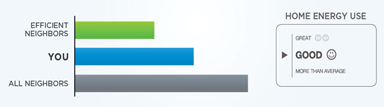
Nudges gone wrong: A program designed to reduce energy consumption persuaded some Republicans to consume more

OPOWER electricity utilization report. opower.com

By Ray Fisman
Posted Friday, April 23, 2010, at 10:01 AM ET

It's a sad statistical reality: Half of us are below average. But that doesn't stop most of us from clinging to delusions of superiority: We like to believe we're better-looking, smarter, funnier, and more honest than those around us. Now and then, when presented with evidence of our shortcomings, we set to work catching up with—and getting ahead of—the Joneses. A decade ago, I caved in and bought a cell phone when I read that the median American owned one.

Psychologists and behavioral economists hope that our tendency to benchmark our own achievements using the performance of others might provide a way to encourage Americans to become better citizens. Can the fear of being below average persuade us to reduce our electricity consumption, increase our charitable contributions, and otherwise compete to be better citizens?

One problem with this approach is that we all define "better" differently, as a new study emphasizes. UCLA economists Dora Costa and Matthew Kahn analyzed the impact of an energy-conservation program in California that informed households about how their energy use compared with that of their neighbors. While the program succeeded in encouraging Democrats and environmentalists to lower their consumption, Republicans had the opposite reaction. When told of their relative thrift, they started cranking up the thermostat and leaving the lights on more often. …

Why would some energy-conscious Republicans all of a sudden become power hogs? One explanation is that many conservatives don't believe that burning energy harms the planet, so when they learn that they're better than average, they become less vigilant about turning the lights off. That is, they're simply moving closer to what they now know is the norm (what psychologists call the boomerang effect). Costa and Kahn also look for guidance from the patron saint of right-wing fundamentalists, Rush Limbaugh, who encouraged his listeners to turn on all their lights during Earth Hour. Costa and Kahn suggest that ardently right-wing electricity customers might respond to paternalistic nudges by burning more energy, just to thumb their noses at Big Brother. …

Nudges Gone Wrong

Tuesday, October 20, 2009

Seattle City Light is first utility to offer Microsoft Hohm to customers

 microsoft hohm page image

Microsoft's Sustainability blog announced Hohm's first utility partner - Seattle City Light. Customers of the utility will start to be able to use Hohm to track their energy usage and get rolling on conserving electricity.

Microsoft Hohm is an easy-to-use online dashboard that shows a user their energy consumption data. It also provides customized tips and recommendations for the user on how to conserve energy. The program was in beta mode back in June, and Seattle City Light was one of nine utilities with which Microsoft partnered to test Hohm. Now, it's the first utility to allow its customers to connect to Hohm and use the information generated from their utility account. …

Seattle City Light Is First Utility to Offer Microsoft Hohm to Customers

Technorati Tags:

Monday, September 14, 2009

At last, an LED bulb worth talking about

Other LEDs disappoint, but the new bulb from Philips has the power to drag low-carbon spotlights out of the shadows

clip_image001

I've tried everything to resist but I'm afraid this post is going to start with a cliche: I've seen the light. The shadows have receded. You get my drift. Last week incandescent lightbulbs began their long-awaited march out of existence and, at the same time, the next generation of ultra-low-power lightbulb has come a step closer to practicality.

I'm not talking about the compact fluorescent lightbulbs (CFLs) that everyone is busy replacing their energy-wasting incandescents with. Instead, I mean the bulb that is one technological step beyond CFL, the LED. Until now, LEDs have been a disappointment for everyday use but Philips has come up with a new bulb that will hopefully make the doubters shut up.

As part of my plans to green my house and, in preparation for the departure of the age of the incandescent bulb, I've been researching the best way to replace the lights in my home with low-energy alternatives. Some would say I've been quite boring and obsessive about this – but never let it be said that I'd let this research go to waste. …

This month, Philips unveiled its new range of LED bulbs. I was sceptical that they'd be any better than the several I had tried already but, well, something has definitely changed in this technology. The 3W Econic spotlight is a direct replacement for the ubiquitous 35W halogen bulb and claims to have the same light output. When I tried it out, I found that Philips wasn't exaggerating. This is brighter than any other LED I've come across. Putting two in our small shower room, after a while I forgot that the bulbs were not halogens. …

At last, an LED bulb worth talking about

Technorati Tags:

Wednesday, August 19, 2009

Australian solar-powered air conditioner up to 12 times more efficient

Federal grant to help achieve commercial launch by 2011

By Yvonne Chan in Hong Kong, BusinessGreen

An Australian company has said it is developing a solar-powered air conditioner that it claims is 12 times more energy efficient than conventional models.

Air Change, a Sydney-based maker of heating, ventilation and air conditioning systems, last month received an A$458,000 (US$377,800, £230,600) grant from the federal government to help put its solar-powered invention into commercial production by 2011.

The company says its Green Machine air con eliminates the need for compressors and ozone-depleting refrigerants. Instead of using an electrical compressor found in conventional models, Air Change's technology uses a solar-powered thermal compressor.

The compressor uses ejector cooling technology in which compressed air expands out of a jet that sucks refrigerant and air into a line. The jet then expels the air at a much cooler temperature. The refrigerant is recirculated and recompressed. Any form of refrigerant, including water, can be used.

Air Change said it has designed models for both homes and commercial buildings, and that The Green Machine can be installed in new properties and also be retrofitted into existing structures. …

Australian solar-powered air con uses sun to beat the heat

Wednesday, July 29, 2009

McKinsey must-read: U.S. can meet entire 2020 emissions target with efficiency and cogeneration while lowering the nation’s energy bill $700 billion!

McKinsey U.S. big 

More than perhaps any other company, McKinsey has documented how an aggressive energy efficiency strategy sharply lowers the cost of climate action (see “McKinsey 2008 Research in Review: Stabilizing at 450 ppm has a net cost near zero”).

Today they released their most comprehensive analysis to date of this country’s energy efficiency opportunity, “Unlocking energy efficiency in the U.S. economy.”  Bottom line:  If this country get serious about energy efficiency — for instance, by passing a climate and clean energy bill like Waxman-Markey — then we can sharply reduce existing emissions at a large net savings to the public and U.S. businesses.  McKinsey has a new cost-curve just of efficiency measures:

The width of each column on the chart represents the amount of efficiency potential (in trillion BTUs) found in that group of measures….  The height of each bar corresponds to the average annualized cost (in dollars per million BTU of potential). …

McKinsey must-read: U.S. can meet entire 2020 emissions target with efficiency and cogeneration while lowering the nation’s energy bill $700 billion!

Monday, April 6, 2009

NEC Creates Online Game to Make Monitoring Power Consumption Fun

 carbon-ball-game.jpg

Image via Pink Tentacle

For some of us, monitoring our power consumption is already a lot of fun, simply because it's a personal challenge. But for most people, it's a chore worse than balancing the check book. That's precisely the reason so many start-ups are working diligently to come up with ways to make monitoring energy use simple, easy, and interesting. NEC, a company always looking for a greener way, has worked with BIGLOBE to come up with an online game that helps spice up tracking your consumption. …

NEC Creates Online Game to Make Monitoring Power Consumption Fun

Sunday, March 29, 2009

Dear deniers and cranks: Earth Hour made a difference

power-use.jpg 

 BlogTO

To all those deniers, cranks, wingnuts and spoilsports who said they were going to turn on their lights, that the generators have to keep running anyways, and that Earth Hour will make no difference, suck on this:

1) Gas and coal fired plants dial up and down all the time to adjust for peak load, so an event like Earth Hour is actually turning down the dirtiest fossil fuel burners, taking it right off the top.

2) In the City of Toronto where I live, to paraphrase a local site, power consumption looked like the Dow JonesScryve Corporate Social Responsibility Rating Industrial Index, dropping 15%.

Save the comments about the CO2 from candles, we know.

Dear Deniers and Cranks: Earth Hour Made a Difference

Saturday, March 28, 2009

Study: New industries ‘extravagant’ energy users

down-the-drainRather than use energy more efficiently than traditional industries, newer types of manufacturing processes — solar panel production, for example — are outrageously energy-inefficient, according to a new analysis from the Massachusetts Institute of Technology (MIT).

Timothy Gutowski of MIT’s Department of Mechanical Engineering led the analysis, which examined the materials and energy consumption of 20 different manufacturing processes.

“The seemingly extravagant use of materials and energy resources by many newer manufacturing processes is alarming and needs to be addressed alongside claims of improved sustainability from products manufactured by these means,” Gutowski and his team write in the journal Environmental Science and Technology. …

Study: New industries ‘extravagant’ energy users

Saturday, March 14, 2009

How to solve global warming for half the cost and twice the jobs as dirty energy

image WASHINGTON — U.S. Sen. Bernie Sanders (I-VT), Greenpeace, the European Renewable Energy Council (EREC), and Dr. Joseph Romm of the Center for American Progress today released a report commissioned from the German Aerospace Center (the German equivalent of NASA) that shows how the United States can meet the energy needs of a growing economy and achieve science-based cuts in global warming pollution – without nuclear power or coal. The report, entitled “Energy [R]evolution,” is co-authored by Greenpeace and EREC and includes a foreword by Dr. R.K. Pachauri, chairman of the Nobel Prize-winning Intergovernmental Panel on Climate Change (IPCC).

The report finds that off-the-shelf clean energy technology can cut U.S. carbon dioxide emissions from fossil fuels by at least 23 percent from current levels by 2020 and 85 percent by 2050 (equal to a 12 percent cut by 2020 and an 83 percent cut by 2050 from 1990 levels) – at half the cost and double the job-creation of what it would take to meet U.S. energy needs with dirty energy sources. …

“What this report shows is that doing what science says is necessary won’t just provide the planet a living future, it actually will create far more jobs and save far more money than business as usual,” said Greenpeace Global Warming Campaign Director Steven Biel.  “And it will do it without exposing us to the unnecessary risks and pointless boondoggles that would come with any further investments in nuclear or coal.”

The blueprint details the specific technologies and timetables necessary to achieve these goals, such as:

  • By using the most energy efficient technologies, total primary energy demand will decline by 24 percent by 2050, while under the reference scenario demand will increase by 40 percent.
  • Renewable energy will grow from just 8.9 percent of U.S. electricity generation in 2005 to 95.2 percent in 2050.
  • Electricity from nuclear, coal, and oil will be completely phased out by 2050.
  • The savings in fuel costs under the clean energy scenario is nearly double the additional up-front investment needed to end our reliance on fossil fuels.
Greenpeace & Senator Sanders: How to Solve Global Warming for Half the Cost and Twice the Jobs as Dirty Energy