Showing posts with label carbon capture. Show all posts

Sunday, October 30, 2011

World’s first vertical forest under construction in Milan

Bosco Verticale by Stefano Boeri. Bosco Verticale is a towering 27-story structure, currently under construction in Milan, Italy. Once complete, the tower will be home to the world's first vertical forest. stefanoboeriarchitetti.net

This design is close to the full realization of an idea that occurred to me around a decade ago, as I pondered how to house 10 billion humans and still have a biosphere. I built a genetic algorithm framework for modeling these kinds of structures, which was used in Gennaro Senatore: Morphogenesis of Spatial Configurations. It’s amazing to see these kinds of structures actually being built; it’s as though the 21st century has finally arrived.

Coevolved high surface area structure, showing human and natural environments woven together. James Galasyn

By Diane Pham
16 October 2011

We've reported extensively on green vertical towers that integrate plant life into their facade, but unlike many of those designs, here's one that goes beyond being a mere concept. Designed by Stefano Boeri - architect, academic and former editor of design and architecture magazine Domus - his Bosco Verticale is a towering 27-story structure, currently under construction in Milan, Italy. Once complete, the tower will be home to the world's first vertical forest.

The Bosco Verticale is a system that optimizes, recuperates, and produces energy. Covered in plant life, the building aids in balancing the microclimate and in filtering the dust particles contained in the urban environment (Milan is one of the most polluted cities in Europe). The diversity of the plants and their characteristics produce humidity, absorb CO2 and dust particles, producing oxygen and protect the building from radiation and acoustic pollution. This not only improves the quality of living spaces, but gives way to dramatic energy savings year round.

Each apartment in the building will have a balcony planted with trees that are able to respond to the city’s weather — shade will be provided within the summer, while also filtering city pollution; and in the winter the bare trees will allow sunlight to permeate through the spaces. Plant irrigation will be supported through the filtering and reuse of the greywater produced by the building. Additionally, Aeolian and photovoltaic energy systems will further promote the tower’s self-sufficiency.

The design of the Bosco Verticale is a response to both urban sprawl and the disappearance of nature from our lives and on the landscape. The architect notes that if the units were to be constructed unstacked as stand-alone units across a single surface, the project would require 50,000 square meters of land, and 10,000 square meters of woodland. Bosco Verticale is the first offer in his proposed BioMilano, which envisions a green belt created around the city to incorporate 60 abandoned farms on the outskirts of the city to be revitalized for community use.

+ Stefano Boeri Architetti

Bosco Verticale in Milan Will Be the World’s First Vertical Forest

Saturday, October 2, 2010

Genetically altered trees and plants could help counter global warming

Phytosequestration, including fossil-fuel offset by bioenergy crops: Potential strategies for phytosequestration and estimated carbon (C) sequestration rates by 2050. Jansson, et al, 2010

Forests of genetically altered trees and other plants could sequester several billion tons of carbon from the atmosphere each year and so help ameliorate global warming, according to estimates published in the October issue of BioScience.

The study [pdf], by researchers at Lawrence Berkeley National Laboratory and Oak Ridge National Laboratory, outlines a variety of strategies for augmenting the processes that plants use to sequester carbon dioxide from the air and convert it into long-lived forms of carbon, first in vegetation and ultimately in soil. Besides increasing the efficiency of plants' absorption of light, researchers might be able to genetically alter plants so they send more carbon into their roots—where some may be converted into soil carbon and remain out of circulation for centuries. Other possibilities include altering plants so that they can better withstand the stresses of growing on marginal land, and so that they yield improved bioenergy and food crops. Such innovations might in combination boost substantially the amount of carbon that vegetation naturally extracts from air, according to the authors' estimates. The researchers stress that the use of genetically engineered plants for carbon sequestration is only one of many policy initiatives and technical tools that might boost the carbon sequestration already occurring in natural vegetation and crops.

The article, by Christer Jansson, Stan D. Wullschleger, Udaya C. Kalluri, and Gerald A. Tuskan, is the first in a Special Section in the October BioScience that includes several perspectives on the prospects for enhancing biological carbon sequestration. Other articles in the section analyze the substantial ecological and economic constraints that limit such efforts. One article discusses the prospects for sequestering carbon by culturing algae to produce biofuel feedstocks; one proposes a modification of the current regulatory climate for producing genetically engineered trees in the United States; and one discusses societal perceptions of the issues surrounding the use of genetically altered organisms to ameliorate warming attributed to the buildup of greenhouse gases.

Genetically Altered Trees and Plants Could Help Counter Global Warming

Saturday, April 17, 2010

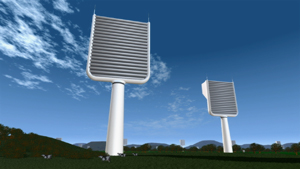
Columbia University joins ‘Synthetic Tree’ venture -- devices would pull carbon from air

'Synthetic trees': an artist's conception Credit: GRT Technologies

posted: 2010-03-15

Columbia University and a research company have entered into a collaboration and licensing agreement for technology that extracts carbon dioxide from the atmosphere, it was announced today. The company, Global Research Technologies, hopes to have units within two years that would capture up to a ton of CO2 a day.

Today, only living plants, atmospheric chemical cycles and other natural systems can pull large volumes of CO2 out of the air. Efforts to snare manmade CO2, released primarily from the combustion of fossil fuels, are not yet viable at a large scale, but some scientists think they hold great promise in tackling climate change. Most financial support so far has gone to projects that capture CO2 at large point-sources such as coal plants--not from the atmosphere at large--and policy makers have focused mainly on reducing emissions by promoting energy efficiency and renewable energy sources.

The technology to be commercialized by GRT has been called a “synthetic tree.” It uses proprietary resins and processes to absorb CO2 from the air, potentially at a rate a thousand times faster than natural trees. The company says that the trees, with a predicted lifespan of 15 years, consume minimal energy during the carbon capture process, and share with other carbon-capture technologies similar energy requirements for storing the resulting carbon. GRT’s founders are Klaus Lackner, director of the Earth Institute’s Lenfest Center for Sustainable Energy, and Allen Wright, a senior staff associate also at the Earth Institute.

“With this technology, we can enter today’s CO2 markets and build for tomorrow’s demand for climate management technologies,” says GRT’s CEO, William Gridley. Gridley sees air capture as economically competitive and complementary to other forms of carbon capture now being developed. He estimates that initial units will be able to capture up one ton of CO2 per day at a cost of less than $100 per ton. GRT plans to sell diluted captured gas as a nutrient for greenhouses and algae farms, and to eventually sell compressed gas for drink carbonation, to make dry ice, and for other niche markets that today total $1 billion to $2 billion per year.

In the long run, Lackner predicts carbon regulation could transform carbon capture into a multibillion dollar market. “By driving cost down to $50 a ton or less, carbon capture can become a cost-effective option for companies looking to meet regulations emerging in Europe, North America and elsewhere,” said Lackner. He hopes the trees can be manufactured in dormant auto plants, restoring lost jobs and breathing new life into local economies, for both national and global economic and environmental benefit.

“One of the unique advantages of this technology is that it makes possible the capture of CO2 from the air anywhere in the world. Unlike the few existing carbon capture approaches, it’s not necessary to co-locate these units with sources of CO2 emissions,” said James Aloise, who manages a portfolio of intellectual property relating to green technology for Columbia Technology Ventures, the university’s technology transfer office, which announced the agreement. “This inherent flexibility and mobility improves access to the technology, which has true potential to make a global impact.”

University Joins 'Synthetic Tree' Venture

Sunday, February 14, 2010

Chemists create synthetic 'gene-like' crystals for carbon dioxide capture

UCLA chemists Omar M. Yaghi and Hexiang Deng led a team that created three-dimensional synthetic DNA-like crystals that have a sequence of information which is believed to code for carbon capture. The discovery, published in the journal Science, could result in a new way to capture heat-trapping carbon dioxide emissions and could lead to cleaner energy. (Credit: CNSI, UCLA-Department of Energy Institute of Genomics and Proteomics)

ScienceDaily (Feb. 12, 2010) — UCLA chemists report creating a synthetic "gene" that could capture heat-trapping carbon dioxide emissions, which contribute to global warming, rising sea levels and the increased acidity of oceans.

The research appears in the Feb. 12 issue of the journal Science.

"We created three-dimensional, synthetic DNA-like crystals," said UCLA chemistry and biochemistry professor Omar M. Yaghi, who is a member of the California NanoSystems Institute (CNSI) at UCLA and the UCLA-Department of Energy Institute of Genomics and Proteomics. "We have taken organic and inorganic units and combined them into a synthetic crystal which codes information in a DNA-like manner. It is by no means as sophisticated as DNA, but it is certainly new in chemistry and materials science."

The discovery could lead to cleaner energy, including technology that factories and cars can use to capture carbon dioxide before it reaches the atmosphere.

"What we think this will be important for is potentially getting to a viable carbon dioxide-capture material with ultra-high selectivity," said Yaghi, who holds UCLA's Irving and Jean Stone Chair in Physical Sciences and is director of UCLA's Center for Reticular Chemistry. "I am optimistic that is within our reach. Potentially, we could create a material that can convert carbon dioxide into a fuel, or a material that can separate carbon dioxide with greater efficiency."

The research was federally funded by the U.S. Department of Energy's Office of Basic Energy Sciences. The lead author is Hexiang "DJ" Deng, a UCLA graduate student of chemistry and biochemistry who works in Yaghi's laboratory. ...

Chemists Create Synthetic 'Gene-Like' Crystals for Carbon Dioxide Capture

Thursday, November 26, 2009

Scottish experiment increases carbon capture efficiency

By Channel 4 News, Updated on 25 November 2009 

It is an advance that could make cleaner coal more affordable.

The technology, known as carbon capture and storage, has been tested at Scottish Power's Longannet coal-fired plant in Fife, which is the third-largest coal-powered power station in Europe, pumping out 800 tonnes of carbon dioxide every year. …

Until now, the process to separate carbon dioxide needed so much energy it would use a third of the power station's output to operate at full scale.

The new process diverts emissions from a chimney into a test unit where they are fed through a chemical solution which includes molecules called amines. …

Scientists say they have now found a chemical mix for the amine that is sticky enough to grab the carbon dioxide but does not need a large amount of energy to extract it.

That makes the whole process more viable commercially.

Scottish experiment cuts coal emissions

Saturday, October 10, 2009

90 percent of Coal Plant CO2 Captured in 12-Month Test


Written by Susan Kraemer
Published on October 9th, 2009

One year ago the French company Alstrom began a year-long US test of capturing CO2 from the water+carbon-dioxide mix created using their chilled-ammonia technology, in the smokestack of the Pleasant Prairie Power Plant in Wisconsin.

This week the year’s results were announced. The years average CO2 capture rate was 90%, according to a joint announcement from the EPRI, We Energies and Alstrom to the Society of Environmental Journalists.

The 12-month test was just completed after running 24 hours a day on a small sectioned-off portion of the smokestack; working on just 5% of the plants total emissions.

But the test is scalable, and the Electric Power Research Institute, the R&D arm of the utility industry, is optimistic that chilled-ammonia technology will work on a larger scale. It is one of several carbon-capture technologies under consideration as we move to a carbon constrained world.

Next, Alstom will work with AEP in Columbus, Ohio to test a scaled-up version of the technology at the Mountaineer power plant in West Virginia.  That test takes the next step as well; not just capturing the carbon dioxide but burying it 8,000 feet beneath the plant site.

Alstom’s chilled ammonia process results in a lower energy cost for capturing CO2 than other techniques under consideration so far. Initial studies currently estimate the average energy penalty at around 20-25% of net boiler output. Alstrom is also working on a technique for capturing carbon dioxide emissions from a gas plant. …

90 percent of Coal Plant CO2 Captured in 12-Month Test

Monday, August 10, 2009

Carbon neutral cement firm ready to build on funding success

Tom Young, BusinessGreen, Tuesday 11 August 2009 at 00:15:00

Fresh from securing £1m in new funding, UK startup outlines plan to roll out CO2 absorbing cement

UK-based startup Novacem announced last week that it has raised £1m in new funding as it seeks to commercialise its carbon absorbing technique for manufacturing cement – a breakthrough that the company claimed could result in a negative carbon footprint for one of the world's most carbon intensive industries.

Currently, the annual production of more than 2.5 billion tonnes of Portland cement is responsible for five per cent of global CO2 emissions, and the sector's carbon footprint is expected to grow with demand for cement volumes expected to double by 2050.

However, Novacem claims that unlike Portland cement, each tonne of cement it produces absorbs three quarters of a tonne more CO2 over its life cycle than it emits.

The company said that its manufacturing process, which was developed based on research undertaken by the Civil and Environmental Engineering Department at Imperial College London, utilises magnesium oxide and special mineral additives that work at lower temperatures than normal cement and ensure that it absorbs atmospheric CO2 as the cement hardens.

Stuart Evans, chairman of Novacem, said that the new investors would help the company expand its research team as it seeks to commercialise the product.

"We are assembling a world-class team and these funds will help us grow the team, complete an initial pilot plant before the end of 2009 and accelerate development and commercialisation," he said. …

Carbon neutral cement firm ready to build on funding success

Saturday, June 13, 2009

Coal: DOE revives FutureGen, reversing Bush-era decision

carboncapture.us

The Obama administration gave conditional support today for a federal-industry partnership that would build an advanced coal-burning power plant in Illinois to trap and store carbon dioxide emissions, reversing a Bush-era decision to abandon the FutureGen project.

The Energy Department plans to contribute slightly more than $1 billion to the project. The announcement follows pressure from Illinois lawmakers -- including Dick Durbin, the Senate's No. 2 Democrat -- who had savaged former Energy Secretary Samuel Bodman's decision to abandon the plan early last year.

With a former Illinois senator now in the White House, DOE has changed directions on FutureGen. President Obama's Energy secretary, Steven Chu, today announced a "provisional agreement" with the FutureGen Alliance, a consortium of major coal and utility companies such as American Electric Power Co. Inc. and Peabody Energy Corp.

"This important step forward for FutureGen reflects this Administration's commitment to rapidly developing carbon capture and sequestration technology as part of a comprehensive plan to create jobs, develop clean energy and reduce climate change pollution," Chu said in a prepared statement.

DOE said FutureGen would be the first commercial-scale, "fully integrated" carbon capture and sequestration project in the country. The plant would marry the use of integrated gasification combined cycle (IGCC) technology with greenhouse gas emission controls. …

COAL: DOE revives FutureGen, reversing Bush-era decision

Friday, May 8, 2009

Pumping CO2 underground best hope for climate: Shell

By Joshua Schneyer

NEW YORK (Reuters) - Projects to capture industrial emissions and store them in the earth's crust could cut CO2 pollution by up to 40 percent, according to officials from oil major Shell.

Carbon capture and storage (CCS) -- gathering CO2 emissions at their source and pumping them underground -- faces steep cost hurdles, but may someday be worth hundreds of billions of dollars a year, a Shell executive said.

"CCS is probably the largest source of potential carbon reduction for the next 30 years, and a way to deal with 30 to 40 percent of (global) emissions," said Kimberly Corley, Shell senior advisor for CO2 and environmental affairs. …

Pumping CO2 underground best hope for climate: Shell