Sunday, May 31, 2009

Anatomy of a silent crisis: human impact of climate change

Here’s the new report by the Global Humanitarian Forum:

Human Impact Report

Climate Change is here. It has a human face. This report details the silent crisis occurring around the world today as a result of a global climate change. It is a comprehensive account of the key impacts of climate change on human society. Long regarded as a distant, environmental or future problem, climate change is already today a major constraint on all human efforts. I has been creeping up on the world for years, doing its deadly work in the dark by aggravating a host of other major problems affection society, such as malnutrition, malaria and poverty. This report aims at breaking the silent suffering of millions. Its findings indicate that the impacts of climate change are each year responsible for hundreds of thousands of deaths with hundreds of millions of lives affected. Climate change is a serious threat to close to three quarters of the world population. Half a billion people are at extreme risk. Worst affected are the world’s poorest groups, who lack any responsibility for causing climate change. …

The findings of report indicate that every year climate change leaves over 300,000 people dead, 325 million people seriously affected, and economic losses of US$125 billion. 4 billion people are vulnerable, and 500 million people are at extreme risk. These figures represent averages based on projected trends over many years and carry a significant margin of error. The real numbers could be lower or higher. The different figures are each explained in more detail and in context in the relevant sections of the report. Detailed information describing how these figures have been calculated is also included in the respective sections and in the end matter of the report. …

Human Impact Report

Technorati Tags:

Saturday, May 30, 2009

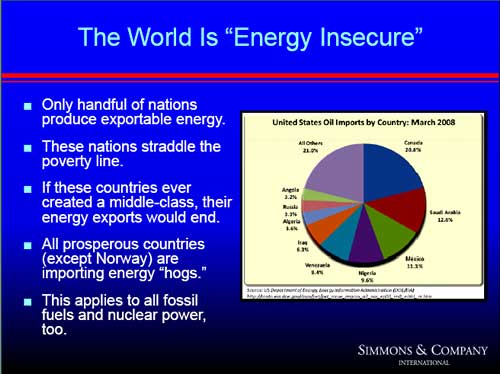
New Matt Simmons presentation

Via The Oil Drum:

New presentation by Matt Simmons: Two Energy Oxymorons: 1. Energy Independence 2. Energy Security (PDF)

G4 Cube given wheels, automation, the will to race Woz's Segway

Not wanting the Allspark to beat them to the punch, the gang at thinkingbricks has given life to an Apple G4 Cube, complete with LEGO Mindstorms NXT-borne retractable wheels, a Bluetooth controller, automation via sensors, and a creepy red LED. That transparent base really makes the wheel deployment much more dramatic, a nice touch if we do say so ourselves. There aren't any step-by-step instructions, but there should be plenty of information at the page if you're thiking of making your own as a weekend project. Either way, be sure to check it out on video, located after the break. …

G4 Cube given wheels, automation, the will to race Woz's Segway

Technorati Tags:

Growing trees into chic, living chairs

growing chair swiss photo 

Image via Yanko Design

If you're not so into hugging trees, how about taking a seat on one? Swiss designer Michel Bussien has designed a new way to help you get up close and personal with nature--by turning it into furniture. The "Growing Chair" shown is a sharply designed mold that allows you to turn greenery into a chic seat. ...

Growing Trees Into Chic, Living Chairs

Friday, May 29, 2009

Cost viability and algae

GreenFuel has called it quits.  I haz a sad.

Posted by Heading Out on May 29, 2009

Robert Rapier recently drew attention to the demise of GreenFuel Technologies, the company founded on ideas from MIT and Harvard and supported by millions of dollars in venture capital funding. One of the creative ideas that the company has was to located their plant at existing power stations so that the carbon dioxide generated in the flue gas could be fed into the bio-reactors holding the algae, with the gas also keeping the algae at an optimal growing temperature. It was a company that was in the vanguard of promoting the use of algae in both carbon dioxide collection and liquid fuels production.

The company, however, ran into problems in raising more money in the current climate, and with the technology. According to to a recent news report:

Getting the whole thing to run smoothly, though, was tougher than expected. GreenFuel could grow algae. The problem was controlling it. In 2007, a project to grow algae in an Arizona greenhouse went awry when the algae grew faster than they could be harvested and died off. The company also found its system would cost more than twice its target.

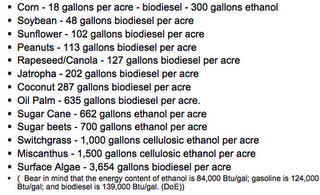
It is that latter part of the paragraph that is the more telling. When folk first consider using algae as a future fuel source, it is often because, when tabulated, algae can produce more fuel per acre per year, than any other crop.

Source Biodiesel - Growing a New Energy Economy - Greg Paul, Chelsea Green Publishing Company, 2005, 281 pages

However, getting what has been achieved in the short term into a production mode that sustains the same yield for year after year is not that easy. Nor is simply finding the best algae the only solution required for the problem.

Given the collapse of GreenFuel, it is perhaps useful to look at some of the things that need to be considered, if you are going to have a shot at a viable algae operation. …

Cost Viability and Algae

Technorati Tags: ,

Thursday, May 28, 2009

French award-winning design for wind turbine towers

By Harry Tournemille

Winners of the 2009 Metropolis Next Generation Design Competition, Nicola Delon, Julien Choppin, and Raphael Menard, have come up with an innovative solution for renewable energy called Wind-It. The proposal: inserting wind-turbines into ailing electrical towers to generate and provide additional power to any existing grid.

The design is innovative on two fronts.

First, it utilizes existing structures, thereby reducing the need to further deface the landscape and build more power-structures. The design is also adaptable to different tower styles, and has the potential to be quite efficient. Delon went so far as to suggest if a third of France’s electrical towers were outfitted with these turbines, they could rival the energy production of two nuclear reactors–approximately 5% of the country’s total electrical demand.

The idea first came about as the three designers commuted regularly on the TGV. They would invariably see wind turbines and electrical structures, but never the two together. Thus, the question was raised, can we combine them? …

French Award-Winning Design for Wind Turbine Towers

Technorati Tags: ,

Concentrated solar power goes mainstream: Lockheed-Martin to build large CSP plant with thermal storage in Arizona

http://www1.eere.energy.gov/solar/images/parabolic_troughs.jpg

What is the best evidence that concentrated solar thermal power (CSP) aka solar baseload is indeed a core climate solution with big near-term — and very big medium-term — promise?  One of the country’s biggest companies, Lockheed-Martin, with 2008 sales of $42.7 billion, has jumped into the race to build the biggest CSP plant with thermal storage.

The CSP market was already exploding (see “World’s largest solar plant with thermal storage to be built in Arizona — total of 8500 MW of this core climate solution planned for 2014 in U.S. alone“).  Now big players are getting on board, as Phoenix’s East Valley Tribune reports…

Concentrated solar power goes mainstream: Lockheed-Martin to build large CSP plant with thermal storage in Arizona

Technorati Tags: ,

Wednesday, May 27, 2009

EIA projects wind at 5% of U.S. electricity in 2012, all renewables at 14%, thanks to Obama stimulus

From Climate Progress:

The renewables safe sources of energy that never run out are coming!  And if it was braggin’ time for wind when wind power hit 1.25% of U.S. electricity generation in 2008, what’ll it be in 2012, when it hits 5%, as projected by the Energy Information Administration?  Well, it’s probably time for a tougher renewable energy standard than the Senate is considering.

Significantly, the EIA, which is the DOE’s independent analytical arm, is no fan of safe sources of energy that never run out.  When I was at the DOE in the mid-1990s, we uncovered a key reason there was so little wind in EIA’s modeling of federal climate action:  Their original forecast had in fact shown a huge upsurge, so the EIA analysts tweaked the model to artificially suppress wind.  And today, the EIA is run by my old friend, Howard Gruenspecht, who was a Bush Sr. holdover at DOE’s office of policy when I started there in 1992 and a Bush, Jr. appointee at EIA.  He ain’t progressive.  Obama should replace him.  But I digress.

So it is all the more shocking that EIA’s remarkable, if little noted, report from last month, Updated Annual Energy Outlook 2009 Reference Case Reflecting Provisions of the American Recovery and Reinvestment Act and Recent Changes in the Economic Outlook projected this response to the Obama stimulus package:

…

EIA projects wind at 5% of U.S. electricity in 2012, all renewables at 14%, thanks to Obama stimulus! Now can we get a stronger renewable standard?

Technorati Tags:

Good news: most ecosystems can recover in one lifetime from human-induced disturbance

wetland restoration photo 

photo: Partners for Fish and Wildlife via flickr.

There's a reason the phrase "let nature take its course" exists: New research done at the Yale University School of Forestry & Environmental Science reinforces the idea that ecosystems are quiet resilient and can rebound from pollution and environmental degradation. Published in the journal PLoS ONE, the study shows that most damaged ecosystems worldwide can recover within a single lifetime, if the source of pollution is removed and restoration work done:

Forests Take Longest of Ecosystems Studied
The analysis found that on average forest ecosystems can recover in 42 years, while in takes only about 10 years for the ocean bottom to recover. If an area has seen multiple, interactive disturbances, it can take on average 56 years for recovery. In general, most ecosystems take longer to recover from human-induced disturbances than from natural events, such as hurricanes. …

Good News: Most Ecosystems Can Recover in One Lifetime from Human-Induced or Natural Disturbance

Technorati Tags:

Tuesday, May 26, 2009

Plastiki boat made of plastic bottles prepares to set sail

plastiki, boat made of plastic bottles 

It’s been several months since we brought you news of the Plastiki, a boat made of 12,500 plastic bottles, so we figured it was time for an update. When we left the Plastiki expedition last, David de Rothschild, the founder of Adventure Ecology, was making preparations to steer his plastic sailboat towards the floating landfill in the Pacific Ocean. Some time has passed, but we’re excited to report that Plastiki is nearly ready to set sail upon the open sea! …

Plastiki Boat Made of Plastic Bottles Prepares to Set Sail

Technorati Tags: ,

Who's laughing now? Tesla Motors now worth half of GM's value (on paper)

tesla motors gm logos photo 

 Photos: Michael Graham Richard

"It's sort of amusing," remarked Tesla co-founder Martin Eberhard. Last week I wrote about Daimler buying an almost 10% stake in elcetric car maker Tesla Motors. Andrew S. Ross, writing for the San Francisco Gate, made an interesting observation. Based on the ±9% stake that Daimler purchased for $50 million, Tesla's valuation is about $550 million. That's about half of GM's market valuation ($1.17 billion)...

Who's Laughing Now? Tesla Motors Now Worth Half of GM's Value (On Paper)

Technorati Tags:

Eating Brazil nuts protects the Amazon rainforest - literally

Patricio Cracking Open Brazil Nut Coco Photo

Image via: Author's collection

Probably the most entertaining interview we conducted during my South American tour with Green Living Project was interviewing Brazil Nut Concession Owners, and in particular, Patricio León. This 75 year old man has been harvesting brazil nuts since he was about 14 years old and is still out doing it, though he admits that now he has staff to help with the work because he’s not as young as he once was. If you’re not familiar with brazil nuts, but have ever eaten a can of mixed nuts, then you’ve probably eaten or at least seen a brazil nut. They’re the really large moon-sliver shaped nuts that you usually find hanging out at the bottom of the canister. Listen up, because eating those directly helps to protect the rainforest.

So who cares about brazil nuts and why does eating them protect the rainforest? Well, when it comes down to it brazil nuts (or castañas, in Spanish) only really grow under healthy, pristine conditions in the rainforest. Thus far, farmers and commercial organizations haven’t really successfully been able to grow the trees in brazil nut plantations, so eating them means you are supporting healthy rainforests. Farmers can’t chop down the surrounding trees to more easily get to the brazil nut trees (which are typically found 1-2 per hectare), because the trees won’t produce as well as if they were in a healthy, primary forest. Patricio told us that the trees that were in “secondary forest” areas produce 2/3 or fewer "seeds" compared with trees that are grow in primary rainforest. ...

Eating Brazil Nuts Protects the Amazon Rainforest - Literally

Big impact of climate change on India's farm yields: World Bank

New Delhi, May 25 (IANS) Dryland farmers in Andhra Pradesh may see their incomes decline by 20 percent, the sugarcane yield in Maharashtra may go down 30 percent, and there may be much more flooding in the Orissa coast, says a new World Bank report.

Pointing out that this will have a serious impact in a country where 57 percent of the people are directly dependent on agriculture, the report, Climate Change Impacts in Drought-and Flood-Affected Areas: Case Studies in India, says the country can improve its resilience to climate change through a combination of measures and right incentives aimed at multiple levels of government.

The report, the first of its kind in South Asia, was released here Monday. It looks at options of adaptation to climate change in two drought-prone regions of Andhra Pradesh and Maharashtra and a flood-prone region in Orissa.

“Although climate change impacts may take decades to manifest, there is a need for action now to avoid higher future costs and missed opportunities associated with a development path that compromises on climate risk management,” said Richard Damania, environmental economist in the World Bank and leader of the study.

“For example, the report says incomes on the small rain-fed farms in Andhra Pradesh could decline by five percent under modest climate change and by over 20 percent under harsher conditions, bringing farmers closer to, and in many cases, under the poverty line.

“Many of the actions and policies that would build future climate resilience produce development benefits here and now. Focussing on these measures would thus yield a double dividend for development and climate sustainability.”

At the release of the report, acknowledging the need for action, J. Mauskar, additional secretary in the Ministry of Environment and Forests, said: “This report endorses our approach and shows the way forward in addressing future problems.” …

Big impact of climate change on India's farm yields: World Bank.

Technorati Tags: ,

Monday, May 25, 2009

Wind and solar-powered street lighting skips the grid


French company Windela has created a street lighting system that works without any connection to the grid. The Windelux is powered by both a small vertical wind turbine and a solar PV panel.

The lamp is comprised of 84 LEDs and automatically switches on when a photosensitive cell detects that it's dark. A built-in control system stops the wind generator if the wind speed is too high and also allows the pole to act as a Wi-Fi relay.

Inside the pole is the battery that makes all this possible. A rechargable LiFePo battery stores the energy generated by the solar PV panel and wind generator and supplies four nights worth of light before needing to be recharged.

Street lighting accounts for a huge percentage of most cities energy use and costs. The Windelux seems to be an ideal solution for providing both street lighting and distributing Wi-Fi, without ever touching the grid. Currently, units have only been installed in France and Algeria, but it'd be great to see the technology make it's way across the Atlantic. …

Wind and Solar-Powered Street Lighting Skips the Grid

Technorati Tags: ,

Window Farms: An experiment in urban agriculture

window farms, britta riley, rebecca bray, city food sources, urban food source, diy gardening, urban agriculture, urban ecology, urban farming, environmental diy project, eco diy project, environmental diy project, urban gardening 

Gardening enthusiasts living in cities will certainly cheer for Britta Riley and Rebecca Bray’s Window Farms experiment. The artist-in-residence duo at Eyebeam have teamed up to develop a DIY system for creating “suspended, hydroponic, modular, low-energy, high-yield light-augmented” vertical gardens that will enable anyone to start their own garden right in their very own window. Britta and Rebecca were showcasing their prototype at Eyebeam last week and have enlisted a dozen or so volunteers that are building their own farms — all to go on display in windows throughout NYC from May 31 to July 14. …

Window Farms: An experiment in urban agriculture

Technorati Tags:

Gordon Graff’s Skyfarm for Toronto

gordon graff, skyfarm, canada, toronto, vertical farms, urban farms, skyscraper farms, self-sustaining, urban agriculture

The UN predicts that we will need 60% more food over the next 30 years in order to meet the demands of the world’s ever-growing population, and one designer has found an interesting place to look for other alternatives for growing food as agriculturally viable land becomes more and more scarce. That is, up! Skyfarm is a vertical farm designed by Gordon Graff, a student in the Master of Architecture program at the University of Waterloo. The vertically set farm for Toronto is intent on meeting the needs of a tightly packed planet in the face of a limited food supply, while removing dependence on the food transportation via energy intensive and emission heavy methods. 

Gordon Graff’s Skyfarm for Toronto

Technorati Tags:

Rapid climate change forces scientists to evaluate 'extreme' conservation strategies

 A tortoise on the edge of Athens, Greece. (Credit: Dov Sax)

Scientists are, for the first time, objectively evaluating ways to help species adapt to rapid climate change and other environmental threats via strategies that were considered too radical for serious consideration as recently as five or 10 years ago. Among these radical strategies currently being considered is so-called "managed relocation." Managed relocation, which is also known as "assisted migration," involves manually moving species into more accommodating habitats where they are not currently found.

A new, ground-breaking tool to help decision-makers determine if, when and how to use managed relocation is described in the May 25, 2009 issue of the Proceedings of the National Academy of Sciences (PNAS) by a multi-disciplinary working group.

Partially funded by the National Science Foundation (NSF), the working group is co-led by Jessica Hellmann and Jason McLachlan of the University of Notre Dame, Dov Sax of Brown University, and Mark Schwartz of the University of California at Davis. David Richardson of Stellenbosch University in South Africa led the writing of the paper.

The researchers' tool is ground-breaking because managed relocation has been categorically eschewed by some scientists for fear that relocated species would overpopulate their new habitats, cause extinctions of local species, or clog water pipes as invasive zebra muscles have done in the Great Lakes. Nevertheless, some conservationists and groups have already used managed relocation or are currently considering doing so. …

Rapid Climate Change Forces Scientists To Evaluate 'Extreme' Conservation Strategies

Technorati Tags: ,