Greenpeace & Senator Sanders: How to Solve Global Warming for Half the Cost and Twice the Jobs as Dirty Energy
WASHINGTON — U.S. Sen. Bernie Sanders (I-VT), Greenpeace, the European Renewable Energy Council (EREC), and Dr. Joseph Romm of the Center for American Progress today released a report commissioned from the German Aerospace Center (the German equivalent of NASA) that shows how the United States can meet the energy needs of a growing economy and achieve science-based cuts in global warming pollution – without nuclear power or coal. The report, entitled “Energy [R]evolution,” is co-authored by Greenpeace and EREC and includes a foreword by Dr. R.K. Pachauri, chairman of the Nobel Prize-winning Intergovernmental Panel on Climate Change (IPCC).
The report finds that off-the-shelf clean energy technology can cut U.S. carbon dioxide emissions from fossil fuels by at least 23 percent from current levels by 2020 and 85 percent by 2050 (equal to a 12 percent cut by 2020 and an 83 percent cut by 2050 from 1990 levels) – at half the cost and double the job-creation of what it would take to meet U.S. energy needs with dirty energy sources. …
“What this report shows is that doing what science says is necessary won’t just provide the planet a living future, it actually will create far more jobs and save far more money than business as usual,” said Greenpeace Global Warming Campaign Director Steven Biel. “And it will do it without exposing us to the unnecessary risks and pointless boondoggles that would come with any further investments in nuclear or coal.”
The blueprint details the specific technologies and timetables necessary to achieve these goals, such as:
- By using the most energy efficient technologies, total primary energy demand will decline by 24 percent by 2050, while under the reference scenario demand will increase by 40 percent.
- Renewable energy will grow from just 8.9 percent of U.S. electricity generation in 2005 to 95.2 percent in 2050.
- Electricity from nuclear, coal, and oil will be completely phased out by 2050.
- The savings in fuel costs under the clean energy scenario is nearly double the additional up-front investment needed to end our reliance on fossil fuels.
Saturday, March 14, 2009
How to solve global warming for half the cost and twice the jobs as dirty energy


Washington biotech company working to save bamboo and save the planet

Bamboo products have exploded in the market recently. Bamboo is being used in flooring, textiles and all sorts of household items. Its popularity is based on its reputation as a sustainable material. It's a hardy plant that can thrive without the use of pesticides and in many climates and it grows quickly, so what is cut down can be easily replaced. At least that's what has been assumed.
It turns out that bamboo's popularity has led to it being over-harvested and not only is it not being replaced quickly enough with new growth, but many species are on the verge of extinction. Even though it grows quickly, turns out it's very hard to propagate from seeds. That's where Booshoot Gardens, a biotechnology company, comes in. They have figured out a way to propagate bamboo species through tissue culture and are cultivating various species in mass amounts in their greenhouses in Washington state. …
Biotech Company Working to Save Bamboo and Save the Planet
Spain breaks wind power generation record

Spain got a jolt of renewable energy last week when a large gust of wind generated 40 percent of the country’s power. The gust, which was part of a spell of windy weather, generated 11,180 MW.
Spain Breaks Wind Power Generation Record
Friday, March 13, 2009
Carbonscape: Microwaved biochar for massive carbon sequestration

Carbonscape - Developing Industrial-scale Carbon Capture
Biochar, or the concept of turning woody materials into charcoal that is buried, or tilled into soil, is a hot topic. Tim has explored the benefits of biochar for carbon sequestration and soil fertility before, April has talked about biochar trials in Belize and there are the beginnings of an interesting conversation about biochar on the TreeHugger forums. Now a company with offices in the UK and New Zealand is hoping to take these ideas and apply them on a massive scale - utilizing giant microwaves to turn wood into charcoal and bury it in the ground.
Carbonscape is the brainchild of Chris Turney, a professor of geography at the University of Exeter, who has built a 5 meter long prototype as proof of concept. According to The Guardian, Carbonscape's biochar project is setting its sights high in the fight against climate change…
Carbonscape: Microwaved Biochar for Massive Carbon Sequestration
Gore says global climate deal will be reached

LONDON (Reuters) - Former U.S. vice-president Al Gore was quoted as saying he believed a global climate deal would be agreed in Copenhagen later this year because a "political tipping point" had been reached.
Gore, who won an Oscar for his 2006 climate change documentary An Inconvenient Truth, said he believed the support of world leaders, including U.S. President Barack Obama, and many business leaders, had given political momentum to the issue.
Tackling the global economic crisis would provide a framework for a climate deal, he was reported as saying in Saturday's edition of the Guardian newspaper.
"There is a very impressive consensus now emerging around the world that the solutions to the economic crisis are also the solutions to the climate crisis," Gore was quoted as saying.
"I actually think we will get an agreement at Copenhagen." …
Thursday, March 12, 2009
Lithium-Ion breakthrough: A battery that charges as fast as a supercapacitor

Is this the "Holy Grail" Battery We've Been Waiting For? Nature published a very interesting paper by MIT researchers Byoungwoo Kang & Gerbrand Ceder this week: Battery materials for ultrafast charging and discharging. In it they claim that they have discovered a way to make a lithium iron phosphate (LiFePO4) battery charge and discharge about as fast as a supercapacitor...
Lithium-Ion Breakthrough! A Battery that Charges as Fast as a Supercapacitor
Peter Diamandis on the Race to 100 Miles per Gallon (Part Two)

“Radical breakthroughs for the benefit of humanity,” that’s the X Prize Foundation’s stock in trade. In the second part of our conversation with Peter Diamandis, the Foundation’s founder and CEO, we hear about other avenues for creating big changes in the realms of clean energy, space travel, and the importance of crazy ideas. Read or listen to the first part of our conversation here. Listen to the podcast of this interview via iTunes, or just click here to listen, right-click to download.
Peter Diamandis on the Race to 100 Miles per Gallon (Part Two)
5 surprising fashion brands going organic

Photo via Victoria's Secret
Organic cotton t-shirt from H&M, photo via Nitrolicious Most of us, when looking for organic, eco-friendly clothes, know enough to skip the mall; sustainable materials and mass-produced clothes with commercial appeal hardly ever overlap. But we guarantee you'll know these five companies, who have enough recognition and reputation to do whatever they want and yet are choosing to incorporate organic materials and sustainable practices into their most popular items. Who knows? You may even have one (or all) of these stores at your local mall.
1. Victoria’s Secret
Victoria’s Secret has never been an especially green company, with the tons of catalogs sent out every month and the synthetic fiber blends. But over the last few years, in addition to greening the mass mailings, the brand has also introduced beauty products made with organic ingredients from mint to coffee beans—and now offers camisoles, pajama pants, thongs, and panties made from organic cotton. While the organic products are still just a teeny-tiny part of the overall VS empire, they are a step in the right direction. …
5 Surprising Fashion Brands Going Organic
Fighting global warming offers growth and development opportunities
(University of Copenhagen) Combating climate change may not be a question of who will carry the burden but could instead be a rush for the benefits, according to new economic modeling presented today at "Climate Change: Global Risks, Challenges & Decisions" hosted by the University of Copenhagen.
Contrary to current cost models for lowering greenhouse gas emissions and fighting climate change, a group of researchers from the University of Cambridge conclude that even very stringent reductions of can create a macroeconomic benefit, if governments go about it the right way.
"Where many current calculations get it wrong is in the assumption that more stringent measures will necessarily raise the overall cost, especially when there is substantial unemployment and underuse of capacity as there is today", explains Terry Barker, Director of Cambridge Centre for Climate Change Mitigation Research (4CMR), Department of Land Economy, University of Cambridge and a member of the Scientific Steering Committee of the Congress.
"There is some evidence that harder greenhouse gas targets and regulation may actually increase benefits through improved innovation and distribution of low carbon technologies, and increased revenues from taxes or permits. These revenues can be spent to further support new technology and to lower other indirect taxes, ensuring the fiscal neutrality of these measures", says Barker.
"The current global financial crisis must be seen as a timely stimulus to tackling climate change, not a hindrance. If all G20 countries adopted a Green New Deal similar to that proposed by President Obama, the world economy could be greatly strengthened, especially the sectors producing low-carbon technologies," he adds. "But global coordination is critical. Any single country's New Deal may fail if its extra demand for goods and services are met with imports. If we act together, everyone's exports will increase and we can recover employment much quicker".
The prospect of extra growth for the economy from mitigating climate change also raises the possibility of generating funds for helping developing countries adapt to the changes that are now inevitable.
"This 'New Marshall Plan' for the climate would be beneficial to all parties", says Barker. …
Fighting global warming offers growth and development opportunities
Carbon capture and storage
From The Oil Drum:
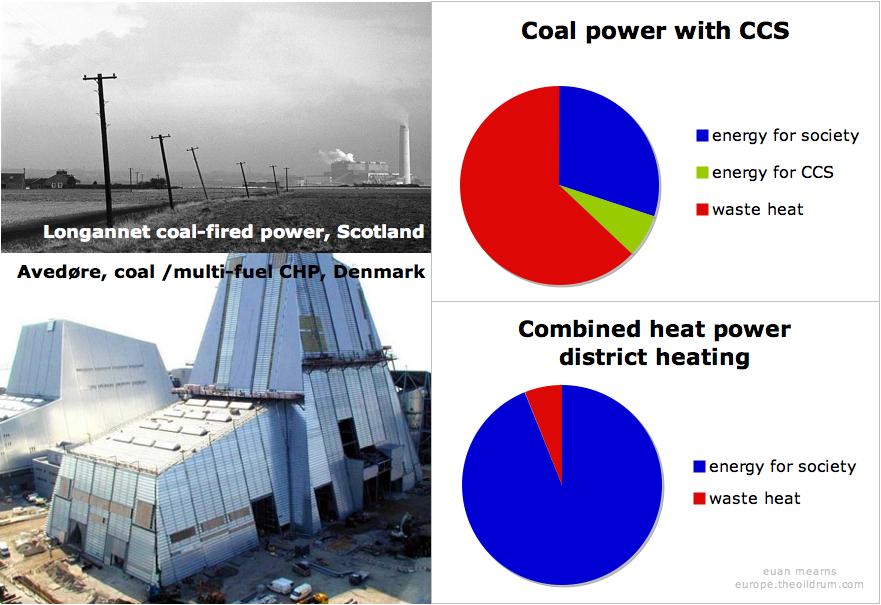
Carbon capture and storage (CCS) involves removing carbon dioxide from the combustion stream of fossil fuel powered generating plant and sequestering it under ground in water-bearing geological strata. The objective is to reduce or eliminate CO2 emissions from electricity generation with focus on coal-fired plant.
CCS has three main elements:
- Capture of CO2 either pre- or post-combustion
- Transport to burial site, normally by pipeline
- Compression and burial in geological strata
The process involves large-scale engineering work, is expensive and uses a significant proportion of the power generated by the plant. The IPCC estimate that the energy cost is somewhere between 20 and 25%. In the UK the average efficiency of coal-fired plant is 37%, with 63% of the energy lost as waste heat. With CCS the energy efficiency drops to 30% assuming 20% of the power produced goes to bury CO2 rather than to power society.
An alternative to CCS is to burn less coal. Combined heat and power (CHP) generation involves capturing the waste heat from power stations and pumping this hot water to neighbouring houses in district heating systems. Danish CHP plant is over 90% energy efficient. Thus 3 times as much energy is extracted per unit of fossil fuel in CHP compared with normal plant fitted with CCS and this may equate to 67% reduction in coal use. Energy costs should therefore be reduced at national and individual level and CO2 emissions reduced by similar amount.
In Denmark, a certain CHP plant is also fitted with CCS. This is truly the belt and braces approach to environmental care. …
Wednesday, March 11, 2009
Europe's energy needs could be met by the Sahara

By Richard Alleyne, Science Correspondent in Copenhagen
Europe's entire energy needs could be supplied by covering an area of the Sahara with solar panels a climate change conference has been told.
By harnessing the power of the sun in an area around the size of Ireland, Europe could easily meet its 2020 target of getting at least 20 per cent of its energy from renewable sources.
"It could supply Europe all the energy it needs," Dr Anthony Patt, of the International Institute for Applied Systems Analysis, in Austria, told scientists at a climate change conference in Copenhagen.
"The sun is very strong there and it's very reliable."
Dr Patt told the conference that calculations show a £50 billion investment by governments over the next ten years would be enough to make Saharan thermal solar power an attractive and viable prospect for private investors.
The technology, which involves turning water to steam by focusing the sun's rays with mirrors, is also becoming cheaper and compares favourably with other forms of solar power, he said.
The cost of moving electricity long distances has come down by around three-quarters, he added.
He said only a fraction of the Sahara, probably the size of a small country, needed to be covered to extract enough energy to supply the whole of Europe.
The sun in the Sahara is twice as strong as it is in Spain and is a constant resource, rarely being blocked by clouds even in the winter. ...
APS commends President Obama's memorandum on scientific integrity
(American Physical Society) The American Physical Society today commends President Obama's decision to sign a Memorandum on Scientific Integrity that will ensure that fact-based, scientific evidence is used in the development of solutions to the nation's most pressing challenges.
"This memorandum rightly places science at the forefront of informing the President, agency leaders and Congress in their development of solutions to issues such as enhancing energy security, revamping health care, and improving science and math education," said APS President Cherry A. Murray.
APS has a long history of using its scientific expertise to inform policymakers on issues of critical concern to the nation. Some of the organization's reports have focused on energy efficiency (www.aps.org/energyefficiencyreport/), nuclear power and proliferation (http://www.aps.org/policy/reports/popa-reports/proliferation-resistance/upload/proliferation.pdf), and nuclear forensics (http://www.aps.org/policy/reports/popa-reports/upload/nuclear-forensics.pdf).
APS commends President Obama's memorandum on scientific integrity
Drought, urbanization were ingredients for Atlanta's perfect storm

(NASA/Goddard Space Flight Center) On March 14, 2008, a tornado swept through downtown Atlanta, its 130 mile-per-hour winds ripping holes in the roof of the Georgia Dome, blowing out office windows, and trashing parts of Centennial Olympic Park. It was an event so rare in an urban landscape that researchers immediately began to examine NASA satellite data and historical archives to see what weather and climatological ingredients may have combined to brew such a storm.
Though hundreds of tornadoes form each year across the United States, records of "downtown tornadic events" are quite rare. The 2008 Atlanta tornado—the first in the city's recorded history—was also unique because it developed during extreme drought conditions.
In a NASA-funded study, researchers from Purdue University in West Lafayette, Ind., and the University of Georgia (UGA) in Athens found that intermittent rain in the days before the storms—though providing temporary drought relief—may have moistened some areas enough to create favorable conditions for severe storms to form and intensify. Additionally, the sprawling urban landscape may have given the storms the extra, turbulent energy needed to spin up a tornado. The researchers reported their findings in January at the annual meeting of the American Meteorological Society.
"The Atlanta tornado, though forecasted well, caught us by surprise because it evolved rapidly under very peculiar conditions during a drought and over a downtown area," said Dev Niyogi, an assistant professor of regional climatology at Purdue and lead author of the modeling study. "We wanted to know why it hit Atlanta during one of the longest, harshest droughts the southeast has experienced. Was it a manifestation of the drought? Does urban development have an effect on such a storm?" ...
Niyogi and Shepherd also found evidence that storm intensity was amplified by the heat-retaining effects of Atlanta's buildings and streets. The "heat island" effect leads to warmer air temperatures in urban areas because impervious surfaces like glass, metal, concrete and asphalt absorb, reflect, and store heat differently than tree or grass-covered land. Urban environments heat the air and cause moisture to rise quickly, creating a "thunderstorm pump" that can fuel or intensify storms. In March 2008, the differences in soil moisture and Atlanta's sprawling land cover may have provided the perfect blend for storms to intensify.
"A thunderstorm, energized by moist pockets within a drought region, grew into a tornado-causing severe thunderstorm because of weather instabilities it encountered at the rural-urban boundary," Niyogi explained.
"Drought and urbanization do not cause the thunderstorms or tornado, but ultimately they added fuel to the fire of an already energized storm," he added. "The variable rain bands created patches of land that were wet and dry, green and not green. The combination created surface boundaries that can destabilize the weather system and energize an approaching storm, providing the one-two punch." …
Drought, urbanization were ingredients for Atlanta's perfect storm
Crickets may predict human survivability during global warming

(University of Central Florida) UCF scientist Wade Winterhalter landed an $860,000 grant from the US Department of Energy for an innovative study involving crickets that may provide clues about whether or not humans can survive global warming.
If successful, Winterhalter's study could provide insights into the impact of global warming on other creatures, their life cycles and their migration patterns – and it could further the understanding of how global warming will affect mankind.
"We, as scientists, are no longer trying to determine if global warming is occurring or if it will be 'bad' for our native wildlife or our domesticated plants and animals," said Winterhalter. "Those questions have already been answered. What this project does is determine exactly how 'bad' it is going to get and how much time we have before these negative consequences will occur."
This is one of the first research projects that links Atmospheric Oceanic General Circulation Models that predict rises in temperature over time with a sound biological model that successfully predicts breeding patterns of a creature.
Crickets may predict human survivability during global warming
Tuesday, March 10, 2009
S&P launches ‘Carbon Efficient’ stock index
Index provider Standard & Poor’s today launches the S&P US Carbon Efficient Index, which will measure the performance of large-cap US firms that have relatively low carbon emissions.
The new index is the first in a series of indices planned to meet investors’ growing demand for environmentally focusing stock market data.
“Organizations around the world are paying greater attention to the impact of greenhouse gases on our climate, as increasingly more investors consider carbon efficiency as an important investment theme,” said David Blitzer, managing director and chairman of the Index Committee at Standard & Poor’s Index Services. “Standard & Poor’s is the first independent index provider to offer a broad US market index with an environmental focus, reinforcing our position as the premier provider of global thematic focused indices.”
Companies listed on the Carbon Efficient Index have their carbon footprints calculated by the environmental data organisation Trucost Plc.
Future eco-focused S&P indices will focus on other areas such as as water and forestry.
S&P launches ‘Carbon Efficient’ stock index
A sober look at biofuels from algae
Large-scale algae-to-biodiesel production is getting tantalizingly close to reality. However, some highly touted production pathways may not be all they are cracked up to be.

By Martin Tampier
First-generation biofuels are based on commonly available agricultural commodities such as wheat or corn. Second-generation biofuels process lignocellulosic biomass, such as corn stover, straw or wood. There is now a lot of talk about third-generation biofuels, which include algae-based biodiesel or ethanol. Seed Science Ltd. spent several months examining the technical and economic feasibility of algae-to-biofuels in British Columbia. As a result, skepticism has surfaced as to whether algae will be part of the biofuels future, whether in British Columbia or elsewhere.
The advantage of growing algae instead of conventional agricultural crops is their very high growth rate, which in turn reduces the surface required to produce a given amount of biofuel. In addition, there is no competition for agricultural land useful for growing food crops since algae can be grown on land unsuitable for agriculture. Big names such as Shell Oil Co. and Chevron Corp., as well as the U.S. military, are investigating biofuels from algae. Over the past few years, some algae start-up companies have been able to leverage several million dollars of investment. So, surely consumers will soon see the first biofuels made from algae at gas stations, won’t they? …
A Sober Look at Biofuels From Algae
Leaked slides show Obama EPA is fast-tracking global warming endangerment finding
From Think Progress:

In April 2007, the Supreme Court mandated that the EPA determine whether greenhouse gases pose a threat to public health and welfare and take action in response. After more than a year of resistance, the EPA released a document of staff findings, which was then quickly attacked by White House political appointees. They also resisted finalizing taking any actions. Today, Greenwire (sub. req’d) published an internal EPA presentation showing that the Obama administration is “fast-tracking” its response to the 2007 ruling, with plans to release its findings in mid-April:
To expand to public health, EPA plans to make connections between climate change and everything from temperatures to air quality and expanded ranges of vector-borne and tick-borne diseases.
The EPA document said dealing with public health and welfare had “solid legal defensibility.”
The Obama EPA’s analysis is significant; the Bush ruling ignored global warming’s effects on public health, focusing only on “welfare and the links between greenhouse gases and visibility, weather, crop damage and soil.” View the slide show here.
Leaked slides show Obama EPA is fast-tracking global warming endangerment finding.

 Posts
Posts


