Showing posts with label fusion. Show all posts

Tuesday, May 24, 2011

U.S. Navy backs fusion reactor project

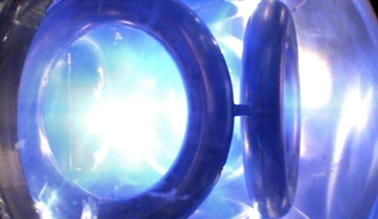
Plasma shines within EMC2 Fusion's WB-7 device, the predecessor to the WB-8 inertial electrostatic confinement vessel currently being used for fusion experiments. EMC2 Fusion

By Alan Boyle
10 May 2011

A Navy-funded effort to harness nuclear fusion power reports that its unconventional plasma device is operating as designed and generating "positive results" more than halfway through the project.

The latest quarterly update from EMC2 Fusion Development Corp. comes amid other signs that seemingly oddball approaches to fusion research may not be all that oddball after all. Just last week, General Fusion announced that Amazon.com's billionaire founder, Jeff Bezos, was part of a $19.5 million investment round to further the company's plan to take advantage of a technology called magnetized target fusion. Another billionaire, Paul Allen, is an investor in Tri Alpha Energy, which is working on its own hush-hush fusion project (and occasionally publishing its research).

EMC2 Fusion doesn't have tens of millions of venture capital to play with — but it does have a $7.9 million Navy contract to test a plasma technology known as inertial electrostatic confinement fusion, also known as Polywell fusion. The idea is to accelerate positively charged ions in an electrical cage to such an extent that they occasionally spark a fusion reaction, releasing energy and neutrons. The concept was pioneered by the late physicist Robert Bussard, and carried forward by the EMC2 Fusion team in Santa Fe, N.M.

Some of the leading team members went on leave from Los Alamos National Laboratory to work on EMC2. Rick Nebel, the Los Alamos engineer who led the company since Bussard's death in 2007, retired from the company last November. Taking his place as acting chief executive officer is Jaeyoung Park. The 41-year-old physicist says he's given up his position at Los Alamos to focus fully on EMC2.

"We had a lot of milestones to meet in the last six months or so," Park told me today. "It's been pretty hectic." …

Fusion goes forward from the fringe

Technorati Tags:

Monday, July 26, 2010

Delays, rocketing costs, and financing problems hit international fusion reactor project

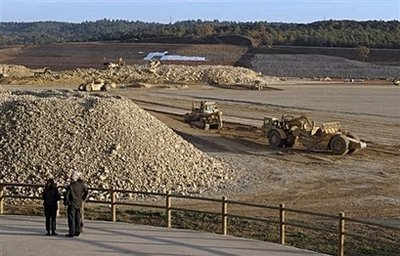
Tractors working on the future International Thermonuclear Experimental Reactor (ITER) site in Cadarache, southern France, in 2008. An explosion in costs has cast a cloud over a multi-billion-dollar nuclear fusion project aiming to make the power that fuels the Sun a practical energy source on Earth. AFP / File / Anne-Christine Poujoulat

By Eloi Rouyer Eloi Rouyer   – Mon Jul 26, 7:09 am ET

MARSEILLE, France (AFP) – An explosion in costs has cast a cloud over a multi-billion-dollar nuclear fusion project aiming to make the power that fuels the Sun a practical energy source on Earth.

Delays, rocketing costs and financing problems have hit the International Thermonuclear Experimental Reactor (ITER) whose consortium members start a meeting on Tuesday aiming to get the project back on course.

ITER was set up by the European Union, which has a 45-percent share, China, India, South Korea, Japan, Russia and the United States to research a clean and limitless alternative to dwindling fossil fuel reserves by testing nuclear fusion.

Work is to start at the test reactor site at Cadarache in southern France next month, but the cost now worries many members.

The total estimated bill for the EU, the main backer, has doubled to 7.2 billion euros (9.2 billion dollars), with the overall cost now reckoned to be around 15 billion euros.

The meeting on Tuesday and Wednesday in Cadarche of ITER's council members marks the start of the construction phase and comes after the EU pledged to pump in extra funds to keep the project going.

The European Commission, the EU executive arm, this month offered to fork out an extra 1.4 billion euros to fulfil Europe's commitment to the project, but this needs the approval of EU member states.

ITER's administrative headquarters and two buildings housing equipment will be the first to be started. …

Nuclear experts seek to advance fusion project

Technorati Tags:

Wednesday, January 13, 2010

Fusion breakthrough a magic bullet for energy crisis?

Traditional methods of harnessing energy may not be enough in the future. Photo / Greg Bowker

By Pat Pilcher

Monday, 11 January 2010

…To date, experimental fusion projects have largely been focused on generating intense heat so they can fuse, and containing the super hot gases from this reaction consumes most if not all of the energy being produced by the fusion reaction.

The University of Florida have taken a different tack, by putting hydrogen and boron fuel into an accelerator that fires them towards each other at incredibly high velocities. When the hydrogen and boron 11 atoms smash into each other, they fuse, producing fast moving helium nuclei whose motion is converted into electricity.

This new process is clean, highly efficient and most important of all, simple. The output of the new reactor is electricity with its by-product being the same helium gas used to make voices squeaky and party balloons float, so there's no toxic radioactive waste to dispose of.

Initial calculations also show that this new type of fusion generation could produce clean electricity at similar levels but far more cheaply than oil or coal.

Because the reactor also operates using relatively simple engineering principles (especially compared to the current crop of fusion reactors), commercialising it is likely to involve significantly shorter time-frames than other fusion technologies.

Although technology is still however very experimental and has yet to be fully proven, a feasibility study into this new fusion process has been kicked off, and if it is found to be viable, it could become commercially available in as little as a decade, here's hoping.

Fusion breakthrough a magic bullet for energy crisis?

Technorati Tags: ,

Friday, July 31, 2009

A new approach to fusion

A startup snags funding to start early work on a low-budget test reactor.

Power pistons: General Fusion's reactor is a metal sphere with 220 pneumatic pistons designed to ram its surface simultaneously. The ramming creates an acoustic wave that travels through a lead-lithium liquid and eventually accelerates toward the center into a shock wave. The shock wave compresses a plasma target, called a spheromak, to trigger a fusion burst. The thermal energy is extracted with a heat exchanger and used to create steam for electricity generation. To produce power, the process would be repeated every second. Credit: General Fusion

By Tyler Hamilton

General Fusion, a startup in Vancouver, Canada, says it can build a prototype fusion power plant within the next decade and do it for less than a billion dollars. So far, it has raised $13.5 million from public and private investors to help kick-start its ambitious effort.

Unlike the $14 billion ITER project under way in France, General Fusion's approach doesn't rely on expensive superconducting magnets--called tokamaks--to contain the superheated plasma necessary to achieve and sustain a fusion reaction. Nor does the company require powerful lasers, such as those within the National Ignition Facility at Lawrence Livermore National Laboratory, to confine a plasma target and compress it to extreme temperatures until fusion occurs.

Instead, General Fusion says it can achieve "net gain"--that is, create a fusion reaction that gives off more energy than is needed to trigger it--using relatively low-tech, mechanical brute force and advanced digital control technologies that scientists could only dream of 30 years ago.

It may seem implausible, but some top U.S. fusion experts say General Fusion's approach, which is a variation on what the industry calls magnetized target fusion, is scientifically sound and could actually work. It's a long shot, they say, but well worth a try.

"I'm rooting for them," says Ken Fowler, professor emeritus of nuclear engineering and plasma physics at the University of California, Berkeley, and a leading authority on fusion-reactor designs. He's analyzed the approach and found no technical showstoppers. "Maybe these guys can do it. It's really luck of the draw."

The prototype reactor will be composed of a metal sphere about three meters in diameter containing a liquid mixture of lithium and lead. The liquid is spun to create a vortex inside the sphere that forms a vertical cavity in the middle. At this point, two donut-shaped plasma rings held together by self-generated magnetic fields, called spheromaks, are injected into the cavity from the top and bottom of the sphere and come together to create a target in the center. "Think about it as blowing smoke rings at each other," says Doug Richardson, chief executive of General Fusion. …

A New Approach to Fusion

Technorati Tags:

Wednesday, June 17, 2009

Fusion falters under soaring costs

Jet tokamak (EFDA) Plasma in a tokamak - a fusion reactor device - can reach millions of degrees

By Matt McGrath, Science reporter, BBC World Service

An international plan to build a nuclear fusion reactor is being threatened by rising costs, delays and technical challenges.

Emails leaked to the BBC indicate that construction costs for the experimental fusion project called Iter have more than doubled.

Some scientists also believe that the technical hurdles to fusion have become more difficult to overcome and that the development of fusion as a commercial power source is still at least 100 years away.

At a meeting in Japan on Wednesday, members of the governing Iter council will review the plans and may agree to scale back the project. …

Fusion falters under soaring costs

Technorati Tags: ,